
Data, Dance, and Daring Campaigns: Erin Levzow’s Approach to Building Loyalty

How Mango Habanero, Metrics, and Masterful Moves Redefined Marketing Genius

Every so often, a guest comes along who doesn’t just raise the bar—they throw it into orbit. Erin Levzow is one of those guests. From the moment she joined The ADOTAT Show, it was clear we were in the presence of brilliance. Erin is a marketing powerhouse, blending emotional intelligence with razor-sharp strategy, all wrapped in a package of humor, humility, and dazzling storytelling. She’s the kind of guest you could talk to for hours and still feel like you’ve only scratched the surface.

Erin isn’t just a marketer—she’s a phenomenon. Whether she’s orchestrating mango-flavored revolutions, leading with radical empathy, or dazzling on the ballroom floor, she approaches every challenge with the perfect mix of creativity and grit. By the end of this episode, we weren’t just inspired; we were in awe. Let’s dive into the magic she shared with us.

The Mango Habanero Revolution: A Case Study in Marketing Genius

Imagine this: a company launches a limited-time flavor, quietly retires it, and suddenly finds itself at the epicenter of a full-blown consumer uprising. This isn’t an exaggeration—it’s the mango habanero saga at Wingstop, and Erin Levzow, the marketing mastermind behind the brand’s response, turned the chaos into one of the most brilliant campaigns in recent history.

“They took out a change.org petition,” Erin said, still marveling at the intensity of the reaction. “That’s like save the whales, but for sauce.”

When Wingstop removed the mango habanero sauce from its menu, Erin’s team didn’t expect much backlash. After all, it was a limited-time offer that wasn’t even a top-seller. But the reaction from fans was immediate, loud, and relentless. Social media erupted with demands for the sauce’s return, and customers didn’t just voice their disappointment—they mobilized.

“We thought about it,” Erin explained, “and instead of coming back to them and being like, ‘Okay, here you go, have it back,’ we talked internally and decided, let’s do this for the people who are really loud about it.”

The team’s strategy was simple but genius: lean into the outrage and make customers feel like part of a movement. They didn’t just bring back the sauce—they launched a guerrilla-style campaign that made fans feel like they were at the center of something special.

“We put together influencer kits and mailed them to approximately 125 people who were very vocal about this,” Erin said. “We got their address by asking them to vote on whether they wanted mango habanero to come back.” Fans who voted were prompted to fill out a form with their name and address, which Wingstop then used to send out the kits.

Each kit was stamped with Viva el Revolución and included stickers, t-shirts, and even a masked character who declared, “We’ve taken over the airwaves to bring back mango habanero.” But here’s the twist: the kits didn’t explicitly say they were from Wingstop.

“There was nothing that said it was from Wingstop, but it was obviously from Wingstop,” Erin said, smiling.

The response was overwhelming. Fans unboxed their kits on social media, posted photos, and speculated wildly about what was happening. “We grew our social reach by a thousand percent overnight,” Erin recalled. “It was unbelievable.”

The campaign didn’t just bring back the sauce—it turned a product recall into a brand-building moment. When the sauce finally returned to menus, Erin noted that it “mixed slightly higher” than before but, more importantly, it drove significant traffic to Wingstop locations.

“We told a story through it,” Erin said, “and people told the story actually on our behalf.”

The Secret Sauce

“It wasn’t just about bringing the flavor back,” Erin explained. “It was about making people feel like they were part of something bigger.”

This story isn’t just about wings—it’s about what makes great marketing. Erin didn’t just respond to customer complaints; she created a campaign that resonated emotionally, turned fans into advocates, and gave the brand a massive boost in engagement and loyalty.

The mango habanero saga wasn’t just a win for Wingstop; it was a masterclass in how to take a seemingly small product issue and turn it into a viral, unforgettable moment. As Erin put it, “We got to make it about them, and that made all the difference.”

The Dance of Data and Storytelling

If you think marketing is all about crunching numbers and analyzing charts, Erin Levzow is here to burst that bubble—and she’ll do it in two sentences flat. “Emotional intelligence and emotional technology really go hand in hand,” she explained. “You have the technology piece—that’s the math base, understanding how to get and when to get to your customer. And then you have the emotional side, the storytelling.”

It’s a deceptively simple idea: blending data and emotion to create marketing campaigns that resonate. But Erin doesn’t just talk the talk; she’s built a career on this philosophy. Whether she’s masterminding a viral campaign or guiding her team through complex strategies, she wields both analytics and creativity with the precision of a Cirque du Soleil performer.

Erin’s approach to marketing is a rare blend of science and art. On one side, there’s the data—the clicks, impressions, and conversion rates that guide decision-making. On the other, there’s the emotional narrative that transforms those numbers into a story worth engaging with. “We have all this data,” Erin said, “but data without a story is just noise. What makes it meaningful is how you connect it back to people’s lives, their emotions, their needs.”

This isn’t just about selling products; it’s about building connections. Erin views metrics as the foundation, but the heart of her campaigns lies in the human experience. Her ability to translate cold, hard numbers into campaigns that make people laugh, cry, or rally behind a mango habanero sauce is what sets her apart.

For Erin, the real magic happens when technology and storytelling come together seamlessly. “It’s not enough to know when and how to reach your customer,” she said. “You need to know why they care in the first place.”

Take, for example, the mango habanero saga. It wasn’t just about analyzing the number of tweets or Change.org signatures demanding the sauce’s return. It was about understanding the emotional undercurrent driving that demand. By tapping into that sentiment, Erin turned a flavor recall into a full-blown cultural moment. “Data tells you what people are doing,” Erin explained, “but it’s the storytelling that tells you why they’re doing it. And that’s where the real opportunity lies.”

Erin doesn’t just analyze data; she orchestrates it like a symphony conductor. To her, every piece of data is a note in a larger melody, and the story she creates from it is the music that captivates her audience. “It’s about making the numbers sing,” she said. “Sure, you can look at impressions, clicks, and open rates, but unless you know how to weave them into a narrative, they’re just stats on a spreadsheet.”

Ballroom Dancing and the Art of Marketing Recovery

Oh, did we mention Erin Levzow is a competitive ballroom dancer? Because of course she is. As if dominating the marketing world wasn’t enough, Erin spends her spare time flipping through the air with the kind of grace most of us can only dream of. But don’t let the sequins and salsa moves fool you—ballroom dancing isn’t just a hobby; it’s a mirror of her approach to work and life.

Take one of her routines, for example—a daring flip where her head was mere inches from the floor. “My partner took a misstep, and I knew in his face my head was about to crash into the ground,” Erin said, recalling the adrenaline and panic of that moment. But instead of unraveling, they adapted on the spot. “We finished the routine as if it was part of the choreography,” she said, laughing at the memory.

If that isn’t the ultimate metaphor for Erin’s career, I don’t know what is. Whether it’s on the dance floor or in a boardroom, Erin doesn’t let a stumble define the story. Her philosophy? It’s not about avoiding failure—it’s about how you recover. “We all fall down,” she said. “It has everything to do with how you get back up.”

This isn’t just a lesson for dancers; it’s a masterclass in resilience for anyone with a pulse. Marketing campaigns flop. Strategies go sideways. Teams make mistakes. Erin knows this better than anyone, but she also knows that resilience isn’t about perfection—it’s about improvisation, adaptability, and finishing strong, no matter how messy the middle gets.

Ballroom dancing may seem worlds apart from marketing, but for Erin, the parallels are striking. Both require trust, collaboration, and a willingness to take risks. And just like on the dance floor, there are moments in her career where the choreography didn’t go to plan. But instead of letting those missteps throw her off, Erin leans into the recovery, finding ways to pivot and turn mistakes into moments of brilliance.

Rick Ross, QR Codes, and Buzzword Burials

Erin’s irreverence for outdated marketing norms is as refreshing as it is hilarious. She’s not here for buzzwords like “omnichannel” or metrics like impressions. “Someone asked me why their impressions were down but revenue was up,” she said, laughing. “And I told them, ‘Who cares about impressions? Your revenue is up!’”

When asked about her favorite marketing pivot, Erin didn’t hesitate to highlight the moment she replaced Troy Aikman—yes, the legendary football player—with Rick Ross as Wingstop’s brand ambassador. Why? Because Rick Ross actually resonated with their 18-to-24-year-old audience. “It didn’t feel relevant or cool to them,” Erin said about Aikman. “But Rick Ross? He made sense. He was already a franchisee and a great cheerleader for the brand.”

And let’s not forget her take on obnoxious trends like QR code Super Bowl ads. “Was it creative? I don’t know,” she quipped. “Was it annoying? A little. But it worked.”

Leadership with Empathy and Radical Candor

Beyond her marketing brilliance, Erin Levzow’s leadership philosophy is a masterclass in empathy and authenticity, the kind that makes you rethink what it means to lead effectively. She doesn’t just manage teams—she cultivates environments where people feel safe to thrive, fail, and try again. At the heart of her philosophy is radical candor, a concept Erin wields with the precision of a sculptor carving out greatness. “If I care about you, I’m going to be direct with you,” she said. “But I’ll hug and love you every step of the way.”

This isn’t some soft, feel-good leadership buzzword. For Erin, it’s about giving people the tools and feedback they need to grow, even when it’s uncomfortable. She doesn’t sugarcoat the truth, but she also doesn’t deliver it with a sledgehammer. Her method is equal parts grit and grace—a balance that’s as rare in boardrooms as it is essential.

Erin also has no patience for the obsession with fixing weaknesses, a mindset she believes stifles potential. She points to Michael Jordan as her quintessential example: “He was the best at basketball, not baseball. Why focus on weaknesses when you can make someone the Michael Jordan of what they’re already great at?” It’s a perspective that’s both practical and visionary. Instead of asking her team to patch up their shortcomings, Erin zeroes in on what they’re already brilliant at, empowering them to excel in areas where they naturally shine.

Her leadership philosophy is as bold and refreshing as her marketing campaigns. Erin isn’t afraid to challenge norms, push boundaries, or ask the hard questions—all while making sure her team feels supported and empowered. She takes the same approach to her team dynamics that she does to her marketing: a perfect blend of logic and emotion, of precision and passion.

And let’s not forget Erin’s sense of humor, which is woven into everything she does as a leader. Whether she’s citing basketball metaphors or admitting that, yes, sometimes you just need a cry-and-White-Claw moment, Erin reminds her team that success isn’t about perfection. It’s about progress, resilience, and learning to lean into what makes you uniquely excellent.

What makes Erin truly stand out, though, is her ability to inspire those around her—not just to do their jobs, but to believe in their potential. She leads with a kind of audacious optimism that’s infectious. “Leadership isn’t about being perfect,” she said. “It’s about figuring out how to get back up after you’ve fallen and helping others do the same.”

The Power of Perseverance: Erin Levzow’s Journey Through Love, Loss, and Lessons

Erin Levzow isn’t just a marketing powerhouse—she’s a human hurricane of resilience, humor, and heart. Beneath her brilliance on the business battlefield lies a deeply personal story that has shaped her outlook on everything, from leadership to living fully. Her husband’s life-altering accident wasn’t just a test of their strength as a family—it was a masterclass in how to endure, adapt, and thrive when the universe throws everything at you, including the kitchen sink.

“Nothing really matters, and yet everything’s important,” Erin said, a philosophy that could only come from someone who’s been to hell and back. Her husband’s recovery from a traumatic brain injury—something doctors said had less than a one-percent chance of happening—isn’t just a miracle; it’s a lesson in what sheer grit and love can accomplish.

But let’s not sugarcoat this: Erin’s journey wasn’t all inspirational speeches and life-affirming moments. “People kept saying, ‘You’re so strong,’ but I felt anything but,” she confessed. “I was a mess. There were days I didn’t want to get out of bed, and the only goal was to sit up, then maybe shower. Baby steps.”

In classic Erin fashion, though, she didn’t just survive—she thrived. During her husband’s recovery, Erin chronicled their journey on a CaringBridge blog, which quickly snowballed into something bigger than she ever imagined. “About 42,000 people read it,” she said, still astonished. “And if I missed a day, people would lose their minds. ‘Is he okay? Are the kids okay?’ It was wild.”

But what really stuck with Erin were the messages she received—people from all over the world sharing how her story had inspired them to keep going through their own challenges. “They’d say, ‘Your journey gave me hope,’ and all I could think was, ‘Me? I’m just trying to get through the day without falling apart.’”

This raw honesty and openness are what make Erin’s story so powerful. She didn’t just chronicle the victories; she let people in on the messy, unfiltered reality of struggle. And in doing so, she gave others permission to admit that they, too, were struggling—and that it was okay.

Even now, the challenges haven’t disappeared. “He still has a traumatic brain injury, and there’s still a lot of trauma,” Erin shared. “The first time I heard an ambulance after everything happened, I collapsed into a corner, crying. I didn’t even know that was PTSD.”

For Erin, the journey has been as much about accepting help as it has been about pushing forward. “People want to help, but we’re so bad at letting them,” she said, a mix of candor and frustration. “Especially as women, we think we have to be strong all the time. But sometimes the strongest thing you can do is admit you need help. Drink a White Claw, cry in a corner, and let people show up for you.”

Her husband’s recovery taught her one of life’s greatest truths: resilience isn’t about being unshakable. It’s about wobbling, falling, and still finding the strength to stand back up. And if that isn’t the ultimate marketing metaphor, I don’t know what is.

Why Erin Levzow Is One of Our Best Guests Ever

Erin Levzow isn’t just a guest; she’s a phenomenon. Her stories, insights, and humor made this episode unforgettable. From mango revolutions to ballroom moves, 

Erin showed us that great marketing isn’t about playing it safe—it’s about taking risks, making connections, and always, always staying authentic.

If you missed this episode, drop everything and tune in now. Erin Levzow just raised the bar for what marketing—and leadership—can be.
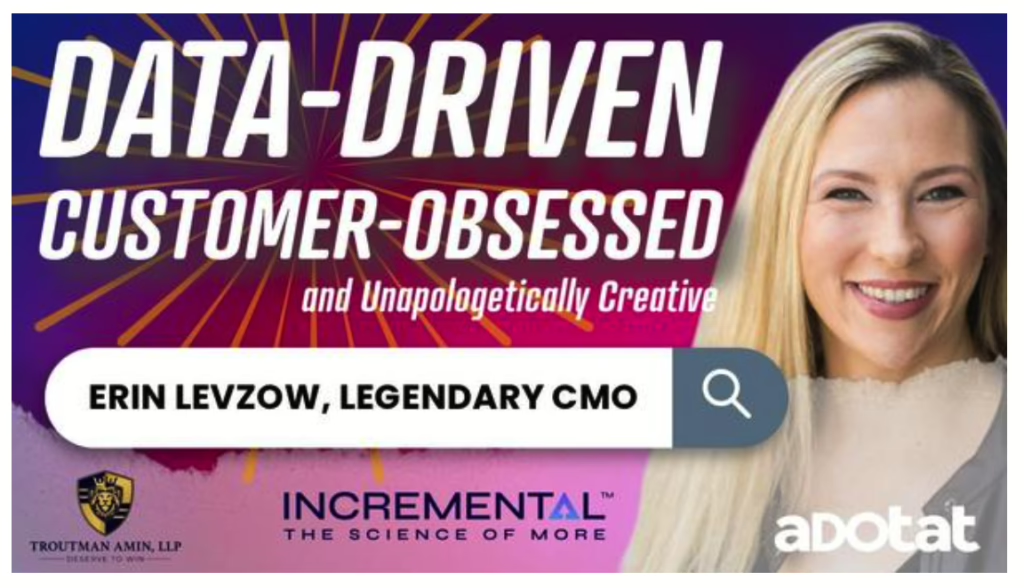

The AdTech Wizard of Odds: Gareth Holmes on Streaming Ads, Helicopters, and Unleashing Sweden’s Secret Sauce 

Adtech is often described as a wild west, but Gareth Holmes makes it sound more like Cirque du Soleil—complete with flaming chainsaws, gravity-defying stunts, and a standing-room-only audience. 

As VP of Strategy Media at SeenThis, Gareth isn’t just navigating the chaos; he’s orchestrating it with the flair of a conductor leading a symphony of algorithms. SeenThis, known for its adaptive streaming technology, has carved out a niche by making ads faster, greener, and frankly, a lot less annoying. Forget static images or bloated video downloads; Gareth’s approach is part eco-revolution, part Jedi mind trick—and entirely effective.

“Streaming Ads Are the Filet Mignon of Formats”

In the smorgasbord of digital advertising, Gareth says streaming ads are the filet mignon, while static images and vast downloads are the equivalent of last week’s cold fries. But what makes these ads so irresistible? Enter adaptive bitrate streaming, a technology that Gareth explains with the kind of geeky enthusiasm you’d expect from someone who compares his work to Spotify’s seamless playback.

“Remember the old days of iTunes?” Gareth asks, conjuring memories of waiting for an ABBA song to download before the party could start. “With adaptive streaming, you hit play, and it just works—because the file is delivered in smaller data packets, not one giant lump.” For brands like Evian, this means ads that play instantly, boosting click-through rates by 152% and slashing CPMs by 36%. Oh, and did we mention the 325 kilos of emissions avoided? SeenThis doesn’t just save your data plan; it saves the planet.

Lazy Meets Paranoid: Why Isn’t Everyone On Board?

Despite the glowing stats, not everyone in the ad industry is rushing to embrace streaming ads. Gareth says the reluctance boils down to an industry-wide case of “lazy meets paranoid.” Agencies, already swamped with deadlines, are hesitant to learn something new, even if it’s as simple as swapping static for streaming. “There are no technical hurdles,” Gareth insists. “It’s a tag-based system that fits right into existing workflows. The real challenge is convincing people to think outside their display-and-video silos.”

This inertia, he argues, is why the ad world moves at the speed of molasses. “People are risk-averse by nature. They wait to see if someone else tries something first, and only jump in once it’s proven not to blow up the internet. It’s frustrating but understandable.”

Sweden’s Secret Sauce

Why does a Swedish company like SeenThis succeed where others flounder? Gareth has a theory: “People trust the Swedes. Sweden doesn’t start wars. It doesn’t cause problems. We show up with IKEA-level simplicity and Viking-level innovation.” That trust translates into less friction when pitching new ideas. Gareth’s method is hilariously straightforward: “We literally hand over a phone and say, ‘Here’s your old vast download, and here’s our streaming version. Watch the difference.’” It’s hard to argue with results you can see.

Manipulation or Evolutionary Brilliance?

Let’s talk about the psychology behind streaming ads, which Gareth describes as “catnip for our lizard brains.” Humans are hardwired to notice movement—it’s a survival mechanism. “If something moves, we look. Streaming ads capitalize on that by starting instantly. If an ad takes two seconds to load, we’re already scrolling past it.”

But this isn’t just about tapping into primal instincts. Gareth rattles off a list of evolutionary quirks that make ads effective:

  • Color Psychology: Red signals urgency; blue evokes calm.
  • Storytelling: We’re suckers for a good narrative.
  • Social Proof: Show popular people using your product, and the herd will follow.
  • Pattern Recognition: Consistency across platforms builds trust.

It’s not manipulation, Gareth insists, but alignment with human behavior. “Ads are meant to encourage action. If they didn’t, what’s the point?”

Static Ads: Dead or Just on Life Support?

Static ads, Gareth says, are running out of time. “I think that they’re pretty much done depending on where in the funnel and such like. But sometimes there are places where you cannot get a video to play in online advertising. If you can get a static and there’s an ad server behind it, then you can stream a video to it as well. So really, I would say anywhere online or an app, I think the days of static ads are absolutely limited.”

But while static ads are fading, Gareth warns against the dangers of going overboard with motion. “I think over-busy is not going to impress anybody, but you use movement to grab the attention and then resonance to hold it,” he explains. For him, it’s all about balance: too little movement and your ad gets ignored; too much, and you risk frustrating your audience.

This balance, Gareth suggests, is the future of online advertising. Movement grabs attention, but it’s resonance—the emotional or contextual connection—that keeps viewers engaged. Static ads might not be extinct yet, but in an industry evolving as rapidly as ad tech, their days are unquestionably numbered.

Zoomers, Boomers, and the Art of Equal Opportunity Brain Hacking

When asked who’s most susceptible to streaming ads, Gareth points to Gen Z and younger audiences. “I think research shows Gen Z or younger audience who are more likely predisposed to be attracted by the movement, given the usage of social and the fact that terms like doom scrolling come from somewhere. So they’re constantly doing it,” he explains.

But movement isn’t just limited to younger audiences. “Movement grabs pretty much all of us equally, but there are some where movement will work slightly better,” he adds, identifying tech-savvy consumers, event-goers, and families with younger kids as key groups that are more engaged by motion-driven advertising.

The Moral Compass in Ad Tech’s Chaos

Ad tech, Gareth says, is like an unregulated finance sector masquerading as a digital playground—equal parts exhilarating and precarious. “The lack of regulation allows innovation to thrive, but it also means we’re relying on relationships and trust, not rules,” he explains, painting a picture of an industry where handshake deals and mutual respect carry as much weight as any written contract. This freedom, while fertile ground for creativity, also demands a steady moral compass—a rarity in a landscape that’s often blurrier than a 3 a.m. drunk text.

So how does Gareth keep himself anchored in such a whirlwind? For him, it all comes down to his upbringing. “I grew up in a military family where humility, honesty, and loyalty weren’t just values—they were expectations,” he says, crediting those lessons for shaping his approach to life and leadership. His early years instilled a no-nonsense ethos that’s both refreshing and disarming in an industry known for its jargon and spin.

When it comes to leadership, Gareth is unequivocal: it’s not about barking orders from a pedestal but about rolling up your sleeves and leading by example. “Leadership, for me, is about servitude,” he says, referencing a principle he lives by. “If serving is below you, leading is beyond you.” This isn’t just lip service; Gareth actively practices what he preaches, emphasizing collaboration over command and demonstrating that true influence comes from action, not authority.

But it’s not always easy to walk the line between ambition and integrity, especially in an industry that thrives on disruption. Gareth admits that the temptation to cut corners or bend the rules can be strong, but he relies on those foundational values—humility, honesty, loyalty—to steer him in the right direction. “It’s not about perfection; it’s about consistency,” he says. For Gareth, staying grounded means treating every interaction, whether with a colleague or a client, as an opportunity to build trust and foster mutual respect.

In a world where the pressure to innovate can sometimes overshadow the importance of ethics, Gareth’s approach is a reminder that success doesn’t have to come at the expense of integrity. By staying true to his principles and prioritizing service over self-interest, he’s managed to carve out a path in ad tech that’s as grounded as it is forward-thinking. For Gareth, the real magic lies in balancing ambition with authenticity, proving that even in the chaos of ad tech, a steady compass can guide you to greatness.

From Math Geek to Ad Tech Maverick

Gareth’s career began in New Zealand, where he left school at 15 and joined the military at 16. After a decade of service, he stumbled into ad tech—a world he initially found baffling but ultimately irresistible. His big break came during the rise of programmatic trading, which he credits with giving “math geeks” like himself a seat at the table. “It wasn’t all shiny suits and flash lunches anymore. It became about solving problems with data and strategy.”

When he’s not juggling ad tech jargon, Gareth lives a surprisingly low-tech life on a farm in New Zealand. “I don’t have neighbors. I just look at the stars and relax.” His one indulgence? Flying helicopters. “It’s hilariously fun and forces you to focus 100%—no time for work stress up there.”

Lessons from a Lifetime

If Gareth could step into a time machine, he’d have a very pointed conversation with his younger self—one that involves a lot of listening and a heavy dose of humility. “You’ve got two ears and one mouth. Use them proportionally,” he’d say, in the kind of tone that suggests he’s learned this the hard way. His teenage self might have scoffed at the idea, but Gareth insists that staying in school would have opened up a world of possibilities. “I left at 15 because it was the easy way out. At the time, I thought I was being clever. In reality, I was just avoiding the challenge.”

And that decision lingers in his mind, not with regret exactly, but with a sense of missed opportunity. “I’d probably be an astrophysicist by now if I’d stuck with it,” he admits, revealing a lifelong fascination with the mysteries of the universe. It’s not just a whimsical idea; it’s on his bucket list to pursue someday. That dream, however, got detoured by a winding career path that wasn’t without its hiccups—and one particular misstep still makes him laugh today.

Picture this: a young, confident Gareth managing a not-insubstantial PPC budget for a telecom giant. Armed with enthusiasm but lacking the nuance of experience, he decided to run a campaign from a pub one afternoon. “I thought I knew what I was doing. I didn’t.” The result? He burned through the entire quarterly budget—hundreds of thousands of pounds—in just a few hours. The kicker? He didn’t even realize the scale of the disaster until it was too late.

“It was one of those moments where you look back and think, ‘What on earth was I doing?’” he says, chuckling now at what was, at the time, a monumental failure. The mistake wasn’t just financial; it was a wake-up call about overconfidence and the importance of asking questions. “I learned that knowing how to do something doesn’t mean you know how to do it well. If you’re not willing to admit what you don’t know, you’re setting yourself up for failure.”

These lessons—hard-earned and occasionally painful—are the foundation of Gareth’s approach today. They’ve taught him the value of preparation, humility, and a willingness to listen, not just to others, but to the situations that demand more thought than bravado. And while he may laugh about that infamous PPC debacle now, it’s clear that the wisdom gained from it continues to guide him.

Closing Thoughts

Gareth Holmes isn’t just an ad tech innovator; he’s a walking contradiction—a math geek with the soul of a philosopher, a military man who preaches humility, and a farm boy who’s reshaping the future of advertising. His advice to the industry is simple: Embrace the chaos, stay true to your values, and never stop innovating. Oh, and maybe invest in a neon-green jet ski—it’s a great way to ride the waves of change.

Adam Brotman’s AI Revolution: How Forum3’s Spok is Rewriting the Marketing Playbook

Adam Brotman isn’t just your average tech executive; he’s the guy who put Starbucks on the digital map. From pioneering mobile ordering to scaling loyalty programs, Brotman turned Starbucks into a tech giant disguised as a coffee shop, cementing his role as a visionary in digital transformation. After a brief stint at J.Crew, Brotman has found himself at the helm of Forum3, a company he co-founded with long-time collaborator Andy Sack. Together, they’re building an AI laboratory that brings the firepower of artificial intelligence directly into marketers’ hands. Their latest creation, Spok, promises to be a game-changer in the world of AI-powered marketing. Brotman describes Spok as “the kind of marketing research and insight-driven planning process that used to take a week, [which] can now be served up in minutes.”

Spok isn’t just another shiny object in the already crowded martech landscape; it’s a carefully crafted solution designed to do the heavy lifting for marketers without requiring a degree in machine learning. Brotman insists, “Spok allows marketers to take full advantage of generative AI, without the marketer having to be an AI prompting expert themselves.” This means that Spok doesn’t just spit out keywords; it synthesizes data and serves up comprehensive strategies, giving marketers time back to focus on creative strategy. Brotman is clear on this: Spok is here to “give marketers insights, content strategies, and marketing plans nearly instantly,” allowing them to work at the speed of AI.

From Starbucks to Forum3: A Journey Through Digital Transformation

Brotman’s career trajectory reads like a masterclass in digital innovation. His role at Starbucks wasn’t just about tech for tech’s sake; he was laser-focused on making technology work for both customers and employees. As the former Chief Digital Officer and EVP of Global Retail Operations, he spearheaded initiatives that redefined Starbucks’ customer experience, from mobile payments to loyalty rewards. His work “included leading all global digital product management and design for the company’s employee-facing digital platforms… and customer-facing digital platforms” and was focused on “omni-channel digital integration, mobile apps, websites, e-commerce platforms and operations, social media, loyalty and data-driven CRM marketing.”

When he moved on to J.Crew, Brotman continued to push boundaries in the retail sector, but his real calling became clear when he co-founded Forum3. In partnership with Andy Sack, Brotman saw an opportunity to leverage AI in a way that would genuinely transform marketing. “We have created an ‘AI Lab’ combining content, software, and services,” Brotman says, explaining Forum3’s core mission. This isn’t just talk; the AI Lab is where they’ve developed Spok and Hive3, two tools that are reshaping how brands think about creativity, strategy, and community in the digital age.

Why Spok? Why Now?

Brotman’s vision for Spok isn’t rooted in the novelty of AI but in the practical benefits it brings to marketers who are under constant pressure to deliver results faster. “Marketing is one of the first areas that will get majorly disrupted and enhanced via AI,” Brotman says, pointing to the fact that marketing is fundamentally about messaging, timing, and audience targeting—all areas where AI excels. By blending leading AI models with third-party keyword data and trend research, Spok offers a holistic marketing assistant that delivers insights in real-time.

In practical terms, Spok is built to handle the nitty-gritty of marketing research so that marketers can focus on strategy and creativity. Brotman explains, “We combine two different leading AI models with 3rd party keyword data and trend research, wrapped together with just the right ‘marketing intelligence’… in an easy-to-use [interface].” The result? Marketers get actionable insights that used to take days or even weeks to compile, all with a few clicks. For Brotman, the ease-of-use aspect is crucial: “Marketers shouldn’t need a PhD in machine learning to use AI effectively,” he says. Spok is designed to democratize access to AI-driven insights, bringing top-tier analytics to marketers of all skill levels.

A Word of Caution: AI Isn’t a Cure-All

Brotman is as cautious as he is optimistic. While he believes that AI holds immense potential for transforming marketing, he warns against jumping on every AI trend. “Marketers should be wary of spending big sums of money and effort on expensive custom AI apps that may be quickly obsoleted,” he says, highlighting the breakneck pace at which AI is advancing. For Brotman, the smarter play is investing in AI education and training so that marketers can leverage existing systems like Spok effectively.

He believes the real value lies not in bespoke AI tools but in mastering how to work with the rapid advancements in the technology itself. “In reality, most of the frontier AI systems are likely going to be so capable over the next year on their own,” he notes, urging marketers to focus on building their AI proficiency. The message is clear: AI is a powerful tool, but marketers need to be strategic in how they deploy it, lest they end up with expensive, quickly outdated tech.

Brotman’s Bold Predictions for AI in Marketing

When it comes to AI’s future, Brotman isn’t shy about sharing his bold predictions. He envisions a landscape where AI doesn’t just advise marketers but actively takes on tasks in a way that almost resembles human agency. Here’s a breakdown of what Brotman sees on the horizon:

  1. AI Agents That Take Action – Brotman predicts that AI agents capable of executing marketing tasks autonomously are just around the corner. “This will lead to totally autonomous (self-driving, so to speak) marketing implementation down the road,” he says. Imagine an AI that doesn’t just tell you what needs to be done but goes ahead and does it, reporting back with results and optimizations.
  2. Text-to-Video Breakthroughs – By the end of the year, Brotman expects AI-driven text-to-video capabilities to improve drastically, making it easy for marketers to generate high-quality video content on the fly. The potential savings in production costs alone could make this one of the most transformative shifts in content marketing.
  3. Conversational Ads That Engage – Brotman envisions a world where ads aren’t just static images or videos but interactive, conversational experiences. “Ads will ‘come to life’ in 2025,” he says, describing a future where consumers can engage directly with brands in real-time through voice, video, and text.
  4. Personalization at Scale – For Brotman, personalization isn’t just a buzzword; it’s a key advantage that AI can bring to marketers. He believes AI will finally make “personalization at scale” affordable and effective, allowing brands to reach audiences with tailored messages that resonate on an individual level.
  5. AI as a Martech Integrator – In an industry cluttered with siloed systems, Brotman sees AI acting as a connective tissue, bridging gaps between disparate martech platforms and data sources. “Because the AI is general-purpose and intelligent, it can unlock a brand’s ability to bring together these systems and data sources without expensive and time-consuming efforts,” he explains.

The Forum3 Vision: A Glimpse Into the Future

Forum3 isn’t just a collection of tools; it’s a blueprint for how AI can elevate marketing from guesswork to data-driven strategy. Brotman is unapologetic about the impact he wants Forum3 to make. “We’re empowering innovation through AI, transforming the way businesses engage with technology and consumers,” he says. Forum3’s AI Lab isn’t just about creating one-off solutions; it’s about building a foundation for the future of marketing.

With Spok, Brotman is once again redefining the rules, pushing the boundaries of what’s possible in marketing. His ultimate goal? To make AI accessible, powerful, and practical for marketers who want to get ahead. For Brotman, AI isn’t a trend; it’s the next frontier. As he puts it, “Our world is going to look completely different in two years because of AI.” If Spok and Forum3 are any indication, Brotman’s not just predicting the future—he’s building it.

Scott Schiller’s Guide to the Mad World of Media, Advertising, and AdTech – Hold the Jargon, Double the Reality Check

Scott Schiller is a man who’s seen it all – from the early days of television ads to the modern, hyper-complicated circus that is digital media. And let’s be clear, Scott’s got opinions. 

He’s made his mark as a media titan, ad tech innovator, and professor who somehow still finds time to remind the industry that it might be taking itself a little too seriously. 

When Scott sat down on The ADOTAT Show, he didn’t hold back. So here’s the wisdom, the wit, and the brutally honest truths from a guy who’s guided some of the biggest brands on the planet and watched more ad tech fads crash and burn than we can count.

Lesson #1: Consumers are the True Kings (and the Industry Just Hasn’t Figured That Out Yet)

“Look, if you think Google or Amazon is running the show, you’re sorely mistaken,” Scott says, shaking his head. “It’s the people on their couches, flipping between the red zone and TikTok, who decide where the money flows.” In his view, advertisers have been chasing after these massive tech giants like puppies at dinnertime, while the real decision-makers – the consumers – are sitting right in front of them.

Scott gets it; he’s seen the rise of platforms where consumer preference drives every decision. His gripe? Advertisers are still acting like the consumer’s role in the equation is “optional.” And don’t even get him started on how tech platforms handle this power. “These companies – the Googles and the Amazons – they’re smart. They know people will keep coming back as long as they don’t screw it up. Consumers vote with their eyeballs and, more importantly, their clicks,” Scott says, raising an eyebrow. “And everyone else is just a little too busy overanalyzing to notice.”

Lesson #2: The Obsession with Perfect Metrics is Killing Creativity

In the relentless quest for perfection, advertisers have lost their way, according to Schiller. “If you’re out here, trying to be precise to the decimal on every metric, you’re missing the point of advertising altogether,” he says. Scott goes on to recall the days before ad tech giants gave everyone a complex about “perfect targeting” and “precision metrics.” Back then, he insists, it was more about gut instinct and knowing your audience.

“Look, people want ads that make them feel something – that’s it. It’s not rocket science,” Scott argues. “But now, everyone is chasing this idea of programmatic utopia, where an ad hits you at the exact right moment in the exact right place. It’s overkill, and it kills any sense of creativity or genuine connection.” He lets out a laugh. “If it doesn’t feel human, it won’t sell. And no amount of targeting can fix that.”

Schiller’s stance on ad metrics is refreshingly cynical. He sees the industry’s fixation with perfecting every single measurement as a never-ending spiral. “We’re drowning in data but starving for insight,” he says bluntly. “The whole thing about ‘getting it perfect’ is just an illusion. At the end of the day, it’s about making ads that don’t make people hit the skip button.”

Lesson #3: Stop Trying to Automate Everything – Human Instinct Still Matters

Here’s one that would send a shiver down the spine of every ad tech startup exec in Silicon Valley: Scott doesn’t buy into the industry’s automation obsession. While the rest of the world is throwing their chips behind AI, Scott’s over here waving the flag for old-fashioned human instinct. “I don’t believe there will ever be a day where advertising is 100 percent automated,” he says. “There’s always going to be a place for instinct.”

And in case you’re wondering, Schiller’s not against data. He just doesn’t see it as a magic solution. “The data gives you a framework, sure. But at some point, someone has to look at it and decide what it means. Otherwise, it’s just numbers on a screen.” Scott recalls a recent conference where a consulting firm claimed that 75 percent of all ads would soon be programmatic. His response? “Maybe 75 percent of digital ads, but try telling that to a brand building a Super Bowl spot. Some things just can’t be reduced to an algorithm.”

Lesson #4: Commerce Media is More Than Just Buying Jennifer Aniston’s Sweater

If you’re in the media world, you’ve probably heard of “commerce media” – the latest buzzword that tries to merge shopping with entertainment. But Scott has been around long enough to know a hype train when he sees one. “Everyone loves the idea that you can see Jennifer Aniston’s sweater on TV and buy it instantly,” he says, referencing the holy grail of shoppable content. “But the behavior just isn’t there yet.”

Scott’s more optimistic about commerce media as a broader concept, something that goes beyond product placements and impulse buys. “What we’re really talking about here is aligning content with consumer intent. It’s not about putting a ‘buy now’ button on everything but figuring out where shopping naturally fits into the viewing experience,” he explains. “Commerce media is coming, but it’s not going to look like a QVC rerun on TikTok.”

He points to Amazon’s latest moves as a sign of things to come, noting that full-funnel advertising is the next logical step. “Amazon isn’t just going to push products; they’re going to turn their entire platform into one giant, seamless shopping experience,” Scott predicts. “And that’s going to redefine what commerce media even means.”

Lesson #5: Ad Tech is a Bloated, Jargon-Filled Monster (and We’re All Complicit)

If there’s one thing Scott can’t stand, it’s the industry’s tendency to complicate the simple stuff. “Ad tech was supposed to make advertising more efficient, but instead, it’s just become this bloated jargon machine,” he says. “Everyone’s inventing new terms for the same old things – and for what? So they can look smart at conferences?”

Scott doesn’t hold back here. He thinks ad tech has lost the plot entirely, spending too much time reinventing itself without ever asking if it’s even necessary. “Every retailer thinks they can run an ad network. Newsflash: it’s a lot harder than it seems,” he says, with a smirk. Schiller argues that just because a company is great at something else – like retail or tech – doesn’t mean they have the chops to pull off a full ad ecosystem.

Lesson #6: Mentorship Isn’t a Deli Counter

As someone who’s mentored a who’s who of media professionals, Scott has strong feelings about what mentorship is – and what it isn’t. “I love helping people, but here’s the thing: it’s not a deli counter,” he says. “You don’t just grab a number and ask for an introduction or a quick fix. Mentorship is a relationship. It’s a give and take.”

Scott’s advice to young professionals? Don’t treat your mentor like a vending machine. “People ask for quick answers, but there are no quick answers. You’ve got to learn to listen, to engage, and sometimes, to make mistakes,” he says. His best career advice? Make yourself invaluable. “Look, this industry is built on relationships. If you’re not adding value, you’re replaceable. It’s that simple.”

Lesson #7: AI is Coming, But It’s Not the Apocalypse

For a guy who’s seen every tech trend from the 1980s to now, Scott isn’t exactly freaking out about AI. “It’s a tool, not the end-all-be-all,” he says. “The media loves to frame AI as either a miracle or a monster, but the truth is somewhere in between.” Scott sees AI as an amplifier, something that can take creative and messaging to new places, but it’s not about to replace the entire ad industry anytime soon.

“People thought streaming would kill cable, that YouTube would kill television, and now they think AI is going to kill creativity,” he says, laughing. “Look, it’s going to be huge, but we’re a long way from AI making Super Bowl ads or writing copy that hits home.” His take? Focus on what AI can help with, not what it might replace. “If it amplifies what you do, use it. If it replaces what you do, maybe rethink your approach.”

In Conclusion: What We Can Learn from Scott Schiller

Scott Schiller is a walking encyclopedia of advertising insights, but he’s no ivory tower intellectual. He’s as likely to tell you to trust your gut as he is to drop a data-driven gem, and he’s skeptical about anyone claiming to have found the “perfect” solution. In a world that’s always chasing the next big thing, Scott is here to remind us that some principles don’t change. Consumers are still in charge, storytelling still matters, and tech is just a tool – not the entire toolkit.

Tune in to The ADOTAT Show for more from Scott Schiller, and remember: if your ad isn’t making people feel something, it doesn’t matter how “precisely targeted” it is.

Laurel Rossi on Marketing’s Shiny Distractions, Linear TV’s Last Gasp, and Why the Industry’s All Bark and No Bite

Let’s be clear: Laurel Rossi isn’t here to join the echo chamber of ad executives talking about “disruption” while sipping their third champagne at Cannes. No, Rossi, who juggles the roles of Chief Marketing Officer and Chief Revenue Officer at Infillion, is here to strip marketing down to its bare bones—and she’s not interested in sugarcoating it. For Rossi, marketing isn’t about joining another panel to talk in circles; it’s about real impact, measurable outcomes, and finally letting go of the industry’s obsession with buzzwords that belong in 2010.

“If it’s not driving impact, what’s the point?” she quips. And she’s not just blowing smoke. Her career has taken her from high-powered roles at Omnicom to selling her own consultancy to Havas, where she ran massive teams like they were small startup labs, cutting fluff and boosting performance. Now, at Infillion, she’s doubling down on the very thing most marketers only like to flirt with: honesty.

Infillion’s IDVx: Where Interactivity Finally Means More than a Button

One of Rossi’s big plays at Infillion has been the launch of IDVx, a video solution that brings “interactivity” back from the land of gimmicky overlays and click-to-nowhere banners. “Most ‘interactive’ ads these days are about as engaging as a stale bagel,” she says with a laugh. “If all you’re giving people is a button to click, you’re missing the whole point of interactive video.”

IDVx, by contrast, is built on the foundation of TrueX’s interactive ad formats, which have been pioneering engagement since the days when most advertisers thought “interactivity” just meant a bigger logo. “With IDVx, we’re blending that TrueX creativity with MediaMath’s programmatic tech,” she explains, “so brands don’t have to pick between impact and scale.” It’s not just a bigger ad budget thrown at the problem; it’s a tool designed to make viewers actually want to engage. “We’re seeing engagement rates that finally back up what video advertising was always supposed to be about,” she says.

State of Video Marketing: “All Flash, No Substance”

Ask Rossi about the state of video marketing, and she’ll tell you it’s in an identity crisis. “Look, everyone’s obsessed with shiny creative campaigns, but most of them are just that—shiny,” she says. The problem? “Most brands are chasing awards instead of actual reach,” Rossi continues, “and they’re getting lost in the spectacle.” She’s seen enough “groundbreaking” campaigns that never actually broke through to viewers, and she’s had it with the idea that viral content alone is enough to justify a marketing budget.

“It’s like we’re in this race to make ads that are beautiful and technically dazzling but don’t even make a dent in recall or sales,” she says. With tools like IDVx, she’s betting on campaigns that don’t just win awards but keep people engaged long enough to actually buy something. “Interactivity was always supposed to mean immersion, not just a distraction. That’s what we’re bringing back.”

Linear TV: Still Alive—But Barely

Rossi has her foot firmly in the digital world, but she’s got a surprisingly soft spot for linear TV, too. Sort of. “Linear TV is like that reliable old dog who’s slower than he used to be but still great at making people feel something,” she says, “but it’s gotta be part of a bigger plan.” Rossi sees linear TV as the last bastion of broad reach, but she’s quick to add that “it can’t just be a dumping ground for leftover budget.” Instead, she argues, it’s about smart integration: pairing linear TV’s reach with digital precision to actually reach the right audience, not just the biggest one.

“It’s like we’re finally realizing that TV and digital aren’t enemies. They’re roommates that need to start sharing a lease,” she jokes. For Rossi, linear TV still has value, but it needs to play nicely with digital—and that’s something most brands still aren’t getting right.

Five No-B.S. Tips for Today’s Media Buyers

When it comes to advice, Rossi is quick and to the point. “You can only slice this thing so many ways,” she says, before rattling off her list of essentials:

  1. Not All Attention is Equal: “It’s not just about getting noticed; it’s about engaging with people who want to notice you,” she says. Rossi believes in what she calls “experiential attention”—the kind of attention where viewers actually choose to watch. “We’ve had enough of the ‘loud and annoying’ era,” she says.
  2. Embrace the Era of Always Shopping: “Forget the old ‘customer journey’—people are shopping all the time now, everywhere they look,” she says. To her, marketers need to stop thinking of awareness as some mystical phase of discovery and start thinking of it as a 24/7 reality.
  3. Put Women’s Sports on Your Radar: “If you’re not sponsoring women’s sports, you’re asleep at the wheel,” Rossi says. With sports stars like Caitlin Clark and Angel Reese making headlines, women’s sports aren’t just an add-on—they’re a growing cultural force. “You’re missing out if you’re not tapping into that.”
  4. Think Beyond the Game: For Rossi, live sports are just one piece of the puzzle. “Gen-Z doesn’t care as much about the game itself as they do about the commentary, podcasts, and the social content around it,” she says. “If you’re not part of the cultural conversation, you’re invisible.”
  5. CTV Isn’t Social Media: “Thinking CTV and social are the same is rookie stuff,” Rossi laughs. Brands that simply drop ads into TikTok or Instagram and expect sales are setting themselves up to fail. “It’s about balancing performance and awareness across platforms, not just shoving content into every feed.”

The Inclusion Café: Cannes, Rosé, and Real Talk on Diversity

This year, Rossi took a different approach at Cannes Lions with her brainchild, the Inclusion Café, a pop-up space at the festival that sparked the kinds of conversations that rarely happen on the Croisette. It wasn’t about platitudes or hollow pledges to “do better.” Instead, it was about tackling the real, uncomfortable truths head-on. “We had everyone from GLAAD to Group Black to the NAACP around the table,” she explains, “and we’re not here for anyone’s ‘nice try’ efforts.”

For Rossi, the Inclusion Café isn’t just a one-time stunt. She sees it as a blueprint for real change. “We’re not in the business of patting ourselves on the back for good intentions,” she says. The goal was to get brands past the stage of talking about inclusivity and into actually measuring and holding themselves accountable for it.

Her advice for brands stepping into the murky waters of inclusivity? “Stop obsessing over getting the language perfect,” she says bluntly. “People want to see actions, not just well-chosen words.” Rossi’s long-term vision for the Inclusion Café goes beyond corporate lip service, envisioning a future where inclusivity becomes a core element of brand identity, not just an add-on for marketing week.

The Bottom Line

Laurel Rossi isn’t here to play nice, and she’s certainly not here to keep repeating the same old industry fluff. She’s calling out lazy tactics, challenging stale strategies, and demanding more from an industry that’s long been comfortable with doing the bare minimum. Whether it’s bringing real interactivity to video ads, making linear TV work harder, or creating spaces like the Inclusion Café, Rossi’s out to hold advertising accountable. And if that makes her some kind of disruptor, so be it. “At the end of the day, if we’re not making an impact, we’re wasting everyone’s time.”

Mark Coleman: The VC Who Tossed the Rulebook (And has a heart)

Meet Mark Coleman, a venture capitalist who doesn’t give a rip about the traditional VC playbook. Management fees? Nope. Early exits? Not his style. And don’t even think about trying to impress him with your ping-pong table or kombucha bar. Coleman is part startup whisperer, part reality check artist, and all about cutting through the nonsense.

In an industry that loves to fawn over “disruptors” who usually end up just reinventing the wheel with shinier PR, Coleman stands out. He’s been in the trenches, sold DoubleClick to Google (no big deal, right?), and now spends his days mentoring entrepreneurs—often while politely telling them to focus on real problems instead of playing Startup Bingo with buzzwords.

Let’s dive in, because this guy is not your average suit.

From the Sweaty-Palmed Trenches to Investor Zen

“So you’ve gone from the ramen-eating, sleep-deprived startup life to the chill investor vibe, sipping artisanal coffee while watching others do the panic dance,” quips Pesach Lattin, kicking off their conversation on The ADOTAT Show. Coleman smiles, the kind of smile that says, “Yeah, I’ve seen some things.”

“We all have careers and paths we follow,” he says, with the serene tone of someone who’s done the 80-hour work weeks and come out the other side alive. Now he’s co-founder of Tambora Ventures, the man behind the curtain for startups looking to make it in a world that’s more likely to chew them up and spit them out than turn them into unicorns.

And here’s where Coleman’s journey gets interesting: he’s not in it for the cliché “giving back” storyline that investors love to preach. No, he’s in it because he genuinely enjoys seeing smart people solve big problems. “I was blessed to be around really smart people,” he says, “and now I’m paying it forward.”

When Founders Drive Into Walls, Coleman Hands Them a Map (Not a Helmet)

Now, if you think Coleman’s the kind of investor who’s going to put out every fire you start, you’ve got him all wrong. He’s not running a daycare for over-caffeinated founders. “We don’t wait for an accident to happen to put a stoplight at that corner,” Coleman explains, matter-of-factly. Instead, he’s all about stepping in before the flames start—because, let’s face it, by the time a founder is putting out fires, it’s probably too late.

Does he enjoy watching his protégés faceplant? Of course not. But he’s also not here to sugarcoat things. “I try not to own the car that they’re driving,” he says, which is basically venture capitalist code for: Your failures are yours to own, but I’ll help you avoid the worst of them.

Coleman’s not a fan of the last-minute rescue. In fact, he avoids the whole knight-in-shining-armor routine. “We like to get ahead of the curve,” he says, sipping his coffee, probably while his portfolio founders are downing espresso shots and praying they hit their next funding milestone.

Ping-Pong Tables? Please. Focus on Margins, Kid.

Remember those startups that spend more time deciding what color their office beanbags should be than on, you know, building a product people actually want? Coleman sees right through that fluff. “I bring it down to basic marketing 101,” he says, reminding everyone that building a business is about solving a problem—not winning the coolest office award on TechCrunch.

And here’s where it gets good: Coleman has a way of cutting through the noise that makes you wish more VCs did the same. “They didn’t go into this to be bankers, to be raising money,” he says, sounding almost exasperated. “They came in to be builders.”

You can almost hear the collective eye-roll when he talks about founders who obsess over branding before they’ve even figured out if their product works. “It’s all about the innovation. Taking it to market. Following their KPIs in the journey,” he adds, dropping business wisdom like it’s a TED Talk no one asked for but desperately needs.

No Fees, No Nonsense: Mark Coleman’s Unorthodox VC Strategy

Here’s where Mark Coleman breaks all the rules. In an industry that practically lives off of management fees—standard issue 2% for most VCs—Coleman just says, “Nah, I’m good.”

“I don’t charge a management fee for my LPs,” he says like it’s the most natural thing in the world, as if every other venture capitalist isn’t listening and clutching their pearls. Why? Because he doesn’t believe in taking money out of the ecosystem. He’s not here to play fund manager; he’s here to actually, you know, fund innovation.

“I thought the big bet was my vision,” he explains. “Let’s all make money together.” If that sounds almost utopian in the cutthroat world of venture capital, it’s because it is. But Coleman is clearly thriving. He’s already on his third fund, with partners who buy into his karma-fueled philosophy.

“I’m a karma guy,” he says, casually tossing out a sentiment that would make most financiers shudder. “I pay things forward… and I haven’t changed it. It’s been working, so it ain’t broke, I’m not gonna fix it.”

The Broken VC World: Coleman’s Not Here for Your Nonsense

If you’ve ever wondered what a venture capitalist who actually calls out the industry’s BS sounds like, wonder no more. Coleman pulls no punches when it comes to his thoughts on the state of the VC world.

“It’s a broken sector,” he says bluntly. “Sadly, a lot of bad actors on both sides.” He’s not just talking about shady founders fudging numbers to impress investors (although there are plenty of those). He’s also calling out investors who don’t do their due diligence and end up funding nonsense.

“I’m not saying I’m the new sheriff in town,” Coleman says, clearly indicating he’s absolutely the new sheriff in town, “but I’m protecting as many people as I can.”

This isn’t idle talk. Coleman’s approach to investing is grounded in his own experience of being a founder, and he’s keenly aware that, without the private sector, innovation dies. “Without private money, there’s no innovation, no investment.”

DoubleClick and Google: The Deal That Changed Everything

When Coleman talks about selling DoubleClick to Google, it’s not with the typical breathless excitement of a founder who cashed out. No, this was a deal made with careful calculation and a bit of pragmatism.

“We were public, went private, took on a PE firm, and were making real-time decisions about what to do,” Coleman recalls. It wasn’t exactly a fairytale exit. In fact, Coleman had two buyers—Google and Microsoft—vying for DoubleClick at the time, and they had to make fast, strategic moves.

Google won the bidding war, but Coleman wasn’t convinced they’d actually keep DoubleClick’s technology. “I was positive they were going to sunset the technology,” he admits. Instead, DoubleClick’s tech became foundational to Google’s ad empire, outlasting even his expectations.

Looking back, does he regret selling to Google? Not a chance. “It was one of the best sales with a great company for an exit. I don’t think I would ever change it again.”

The Israeli Startup Scene: Frogs, Princes, and Kicking Tires

Coleman’s got a soft spot for Israeli startups, but he’s not starry-eyed about it. In fact, he’s been mentoring companies there for years, partly because of his deep personal connection—his wife is a first-generation Holocaust survivor—but also because he sees immense potential.

But Israeli founders, as much as they’re celebrated, sometimes need a little dose of reality, according to Coleman. “It’s too intense,” he says of the culture. The whole “move fast and break things” mentality might work when you’re building apps in Tel Aviv, but taking it global requires a different strategy.

“You can have a nickel for every meeting and a bucket full of change but no money,” he laughs, referencing how some Israeli founders get stuck in a meeting loop without sealing the deal. Coleman’s all about KPIs and moving the needle, not just endless pitch meetings.

The Superpower of Healing (No, Seriously)

At this point, you might be thinking, “Alright, but what does Mark Coleman actually do for fun?”

The answer? Not what you’d expect from a guy who’s reshaping venture capital. Coleman’s big hobby? Gardening. “I love gardening and landscaping,” he says, sounding almost Zen. And when asked what superpower he’d want, he doesn’t opt for something flashy like flying or mind control. Nope. Coleman wants the power of healing. “I’m all about longevity and health and quality of life.”

Not exactly what you’d expect from a venture capitalist, right? But that’s exactly the point. Coleman is not what you expect, period.

Final Thoughts: Don’t Be Evil (But Maybe Be a Little Bold)

Mark Coleman is not your average VC. He’s ditching the management fees, calling out bad actors, and treating his founders like family (without the passive-aggressive holiday dinners). And he’s doing it all without an alarm clock.

His advice to founders? Simple: “Just do good. I always loved Google’s ‘Don’t be evil.'”

In a world where venture capital often seems to be about making money fast and getting out before the market shifts, Coleman is a breath of fresh air. He’s in it for the long game. He’s in it for the people. And while the rest of the VC world might be broken, he’s quietly—perhaps even stubbornly—building something better.

You don’t have to agree with him. But it’s hard not to respect him. And in venture capital, that’s saying something.

WATCH THE FULL EPISODE HERE

Why Jonah Goodhart Thinks Your Feelings Matter More Than Clicks

Let me paint you a picture: I’m sitting across from Jonah Goodhart—yes, that Jonah Goodhart. The ad tech wunderkind who co -founded Moat, sold it to Oracle for a king’s ransom, and then had the audacity to not sail off into the sunset. 

Instead, he’s back at it with Montauk Labs, tinkering away like some mad scientist who refuses to leave well enough alone. We’re supposed to be discussing his latest venture, but naturally, the conversation spirals into a kaleidoscope of topics—from cosmic accidents to the emotional underpinnings of insurance ads. And honestly, it’s a breath of fresh air in an industry suffocating under its own self -importance.

So here they are: ten pearls of wisdom Jonah casually tossed my way, each one sinking deeper into my jaded, tech -weary soul than I’d like to admit.


1. Embrace the Cosmic Accident

“Jonah, what cosmic accident or stroke of brilliance led you here?” I ask, half -expecting a rehearsed monologue about strategic planning and market disruption. Instead, he laughs—a genuine, hearty chuckle that cuts through the veneer of corporate pretense. “Cosmic accident? That’s about right,” he says.

He proceeds to recount how he and his brother Noah stumbled into their first venture while still in college. Picture this: two college kids capitalizing on e -commerce sites in the late ’90s that were practically begging people to take their products for free. No grand vision, no five -year plan—just two guys thinking, “Hey, free stuff is cool.”

“We didn’t know squat about advertising,” he admits. “We were just college kids who thought getting free stuff on this amazing new thing called the internet was neat.” Their ‘business’ was essentially a newsletter highlighting where to snag freebies online. Then Barnes & Noble called—not to sue them for exploiting loopholes—but to offer them a commission. You can’t make this stuff up.

“So suddenly, a business was born,” he says, still sounding slightly incredulous. It’s like tripping over a rock and finding out it’s a gold nugget. Most people would chalk it up to dumb luck, but Jonah turned that cosmic accident into a launching pad.

The lesson? Life doesn’t always need your meticulous planning. Sometimes, it’s about recognizing the opportunity in randomness. While you’re busy plotting your next move, the universe might just be waiting to drop a golden egg in your lap. So keep your eyes open—and maybe, just maybe, answer those unexpected calls.


2. Mentors Matter, Even the Unlikely Ones

“Was there a pivotal mentor or anti -hero that shaped your path?” I prod. Jonah doesn’t hesitate. “Mike Walrath,” he says, eyes lighting up. For the uninitiated, Mike’s the guy who went from selling gym memberships to pioneering digital ad exchanges. Not exactly the linear career trajectory they teach you in business school.

“Mike cold -called me,” Jonah recalls. “He said, ‘I see what you’re doing. You should buy banner ads.'” Now, let’s pause here. Most of us treat cold callers like telemarketers during dinner—necessary evils to be dispatched swiftly. But Jonah listened. Maybe he was bored; maybe he sensed something. Either way, that call led to them buying significant media over a weekend—on a credit card, no less.

Fast forward, Mike leaves DoubleClick and reaches out again: “I’m starting a company. Do you and your brother want in?” They did, and thus Right Media was born, eventually selling to Yahoo for a cool $680 million. Not too shabby for a guy who used to hustle gym memberships.

The real kicker? Mike wasn’t some industry titan or seasoned executive. He was just a guy with hustle, vision, and the chutzpah to cold -call potential clients. Jonah’s takeaway? Don’t underestimate anyone. Wisdom doesn’t always come adorned with titles and accolades. Sometimes, it’s the guy who used to peddle gym memberships who’ll lead you to your next big break.

So the next time you get an unsolicited pitch, maybe—just maybe—don’t hang up immediately. You never know who might be on the other end of the line.


3. Age Is Just a Number, So Ignore It

“Are you the Yoda or Darth Vader in your story?” I quip, expecting a smirk. Jonah chuckles, but then gets serious. Back when he and his brother started, being young wasn’t the asset it is today. Forget Silicon Valley’s fetishization of 20 -something CEOs in hoodies. In the late ’90s, youth was a liability.

“People wanted to know if I had kids, how old I was,” he says. “They’d ask, ‘Who’s the white hair in the room?'” Imagine that. Now, companies are practically throwing money at teenagers who can code a halfway decent app. But back then, Jonah and Noah were so wary of being dismissed that they dodged face -to -face meetings.

“Mike tried to meet us, and we’d always have an excuse,” he admits. “We didn’t want him to realize he was dealing with college kids.” The charade didn’t last forever. One day, someone let slip that Jonah was at a final exam when Mike called. The cat was out of the bag.

Did it matter? Not really. But it underscores how arbitrary metrics like age can be barriers—or perceived ones. Jonah didn’t let societal expectations dictate his path. He knew what he brought to the table, even if others couldn’t see past his lack of crow’s feet.

So what’s the modern takeaway? Ageism cuts both ways. Whether you’re too young or too old in someone else’s eyes, screw ’em. If you have the vision and the drive, that’s what counts. Stop waiting for the world to validate you based on outdated criteria. Forge ahead, and let your work speak for itself.


4. The Art of the Pivot Isn’t Just for Startups

“Was there a decision that made you think, ‘I must have been out of my mind?'” I ask, leaning in. Jonah nods. “Our first company had an offer on the table,” he says. “We could have sold it and been very well off. But we didn’t.”

Cue the collective gasp. They turned down a lucrative exit, and the company eventually fizzled out. Most would consider that a colossal screw -up, the kind you’d lose sleep over for decades. But not Jonah.

“Had we sold, we might’ve been stuck working for the acquirer,” he muses. “We wouldn’t have been free to start Right Media with Mike.” So, in a twist of fate, what seemed like a misstep paved the way for something bigger.

It’s like missing your flight only to find out the plane had mechanical issues. At first, you’re cursing your luck; later, you’re thanking your lucky stars. Jonah sees setbacks not as failures but as redirections.

“Failure isn’t the end; it’s just a plot twist,” he says, shrugging as if it’s the most obvious thing in the world. “Keep the story moving.”

So maybe the next time life kicks you in the teeth, consider that it might be steering you toward a better path. The art of the pivot isn’t just for startups; it’s for anyone willing to see opportunity in adversity. And if you can’t see it, maybe you’re not looking hard enough.


5. Emotion Drives Everything, Even Advertising

“Measurement is shifting towards outcomes and even emotion,” I note. “How do we measure the unmeasurable?” Jonah leans forward, eyes gleaming like he’s just been handed a winning lottery ticket.

“We are emotional beings,” he begins. “We may think we behave rationally, but it’s just not the case.” In an industry obsessed with data points and KPIs, here’s a guy preaching the gospel of feelings.

He dives into how emotions influence consumer behavior more than any A/B test ever could. “Negative emotion isn’t always bad,” he points out. “Sometimes it gets people to take action.”

He brings up life insurance ads—the ones that remind you of your mortality to sell policies. “They tap into anxiety to motivate you,” he says. “It’s twisted but effective.”

Jonah argues that with advancements in AI and machine learning, we can now quantify these emotional triggers. It’s not about manipulating consumers but understanding them on a deeper level. “If we can leverage emotion to understand content better, we can make better decisions,” he insists.

It’s refreshing to hear someone in tech acknowledge the messy, irrational nature of humanity. We’re not just data points on a spreadsheet; we’re complex beings driven by hopes, fears, and desires. And maybe—just maybe—acknowledging that makes for better business and better connections.

So the next time you’re crafting a campaign or making a pitch, remember: Tug at the heartstrings, not just the purse strings. Emotion isn’t the enemy of logic; it’s the engine that drives it.


6. Context Is King, Queen, and the Whole Damn Court

“Let’s delve into context,” I suggest, bracing myself for a jargon -filled monologue. Instead, Jonah surprises me. “My dad wrote a book called Mobian Nights,” he says. “One of his big ideas is that we cannot sidestep context.”

Wait, we’re quoting dad now? And not in a “My dad used to say” folksy wisdom kind of way. Jonah’s father is a retired professor who delves into the philosophy of context and meaning.

“The same piece of content can mean something entirely different depending on where it’s placed and who’s consuming it,” he explains. “Post an article on Medium, and it has one meaning. Post it on The Wall Street Journal, and it carries a different weight.”

He points out that the ad industry has largely ignored this nuance. “We’ve not created metrics to understand how context affects perception,” he laments. “We’ve been giving brands a false sense of security with flawed brand safety measures.”

Jonah believes that with AI, we can revolutionize how we understand and leverage context. It’s not just about avoiding negative keywords or blacklisted sites. It’s about a holistic understanding of the environment in which your content or ad appears.

So, the next time you slap an ad onto a platform without considering the surrounding content, think again. Context isn’t just an accessory; it’s the outfit. And if you mismatch, you’re not just committing a fashion faux pas—you might be undermining your entire message.


7. Work -Life Balance Is a Myth, So Find Joy in the Chaos

“So, how do you maintain work -life balance?” I ask, half -expecting the usual spiel about meditation apps and scheduled downtime. Jonah looks at me like I’ve asked him to explain quantum physics in three words.

“When you do it well, work is life and life is work,” he says. “It’s all merged.”

In an age where everyone’s preaching about ‘unplugging’ and ‘mindfulness,’ Jonah’s take is refreshingly unorthodox. He doesn’t see a divide between his professional and personal life because he’s passionate about both.

“I’m always thinking about things,” he admits. “But when I’m with my family, I try to be fully present.”

It’s not about clocking out at 5 p.m. and shutting off your brain. It’s about integrating your passions so seamlessly into your life that the lines blur—in a good way.

“Stop compartmentalizing,” he advises. “If you love what you do, the lines blur, and that’s perfectly okay.”

So maybe the quest for balance is a wild goose chase. Perhaps the goal should be to find what excites you so much that you don’t mind the overlap. Life is messy and chaotic, but that’s where the magic happens.


8. Surround Yourself with People Who Light You Up

“Any secret strategies on how to stay motivated?” I ask, expecting tips on time management or perhaps a caffeine regimen. Jonah smiles. “Work with great people who are a joy to speak with,” he says simply.

He talks about his team with genuine affection. “I’m thrilled when I get on a call with one of my teammates,” he says. “I literally see a message from them and think, ‘This is going to be good.'”

Imagine that—actually enjoying your colleagues. In a world rife with toxic workplaces and office politics, Jonah’s approach seems almost radical.

“Energy is contagious,” he asserts. “If your colleagues don’t make you feel alive, what’s the point?”

He extends this philosophy to his personal life. “I have four wonderful children and a wonderful wife,” he says. “I’m incredibly proud of them.”

The takeaway? Your environment matters. The people you surround yourself with can elevate you or drag you down. Choose wisely.

So if you’re stuck in a dead -end job with coworkers who make you want to fake a Wi -Fi outage, maybe it’s time to reassess. Life’s too short to spend it with people who don’t ignite your passion.


9. Build Habits Like Your Life Depends on It—Because It Does

“What’s the most unconventional advice you’ve ever received, and did it work out for you?” I ask. Jonah reflects for a moment. “Mike once told me to go out and do 800 meetings to understand the market,” he says. “I literally did 800 meetings.”

Eight. Hundred. Meetings. Most of us complain about attending one pointless Zoom call. But Jonah saw the value in the grind.

“It was eye -opening,” he says. “You learn what problems people are trying to solve.”

He ties this back to the importance of building good habits. “Whether it’s a habit to take a meditation pause or to work out, find what helps you,” he advises. “Consistency isn’t just key; it’s the whole damn door.”

In a culture obsessed with quick hacks and silver bullets, Jonah champions the unglamorous daily grind. It’s not sexy, but it’s effective.

So stop chasing the latest productivity fad. Build habits that move the needle, even if they require more elbow grease than you’d like. Your future self will thank you.


10. Retirement Is for Quitters

“Do you ever see yourself retiring?” I inquire, expecting a nuanced take on future plans. Jonah doesn’t miss a beat. “I don’t,” he states emphatically.

He shares a story about Warren Buffett’s colleague who retired and died the next year. “Let that be a lesson,” he says.

For Jonah, retirement isn’t a goal; it’s a non -entity. “I can’t imagine only playing golf or sitting on a beach,” he says. “I want to stay intellectually curious and positively impact others.”

It’s a stark contrast to the societal narrative that we should work ourselves into the ground and then spend our golden years doing… well, nothing of consequence.

“Passion doesn’t have an expiration date,” he declares. “If you’re lucky enough to find work that excites you, why would you ever want to stop?”

So perhaps we need to rethink the entire concept of retirement. If you’re doing something you love, the idea of stopping becomes irrelevant. Keep the fire burning until the wheels fall off.


Final Thought

As our conversation winds down, I pose one last question. “If you could go back and give your younger self one piece of advice, what would it be?”

“Build good habits, reduce stress, and surround yourself with people you care about,” he replies without hesitation. “Optimize for happiness.”

And there it is. Not some earth -shattering revelation, but a simple truth that we often overlook in our relentless pursuit of success.

Jonah Goodhart isn’t just another name in the ad tech world. He’s a testament to the power of embracing randomness, valuing unlikely mentors, defying arbitrary norms, pivoting when life demands it, understanding the emotional core of humanity, recognizing the paramount importance of context, finding joy in the beautiful mess that is life, surrounding yourself with people who elevate you, committing to the unsexy work of building habits, and rejecting the notion that passion has a sell -by date.

In a world obsessed with the next big thing, maybe it’s the timeless truths that make the biggest impact. So take a page out of Jonah’s playbook. You might just find that the keys to success—and happiness—have been right in front of you all along.

Ad Tech Survivor: Raj Chauhan’s Escape from the Island of Overengineered Data

Let’s start with the obvious: Raj Chauhan has been around the block. And I don’t mean the block you stroll around on your morning jog. No, Raj’s block is more like an endless digital loop, filled with broken banner ads, DSPs, SSPs, and a short but intense detour into cannabis—because why stick with one volatile industry when you can juggle two? He’s been playing in the digital advertising sandbox since 1995, back when we still believed AOL chat rooms were the height of innovation and “you’ve got mail” was a daily thrill.

Raj’s career is the stuff of ad tech legend—if your idea of a legend is someone who went from building ad networks in the ’90s, back when digital ads were the Wild West, to dipping into the green pastures (pun intended) of cannabis, and finally resurrecting himself as the man to watch in the future of retail media. In short, Raj’s story is the “phoenix rising” of ad tech, only with fewer ashes and more regulatory nightmares.

The Wild West Days of Digital: Raj’s Early Start

Rewind to 1995: the internet was in its awkward teenage years, and digital advertising was barely crawling. Banner ads were the new kid in town, and Raj was part of the crew that built the first ad networks. If you ask him what it was like back then, he’ll tell you it was more like a flea market than the data-driven juggernaut we know today. “There was a lot more kind of hand-to-hand combat,” Raj says, reminiscing about those days when deals were closed with a handshake, and you could actually get to know the people you were working with. It was personal. It was messy. And it worked.

But it wasn’t just the relationships that made those days different—it was the lack of noise. No algorithms feeding you data points until your head spins, no real-time bidding that takes human judgment out of the equation. “Back then, there was no concept of marketplaces,” Raj explains. “We were just serving up ads. There wasn’t a lot of data.” Imagine that: ads without data. It’s like trying to sell a car without mentioning the horsepower.

This was the golden era of banner ads—well, if by “golden” you mean clunky, inefficient, and completely devoid of targeting. Raj, like every pioneer in a new industry, was figuring it out on the fly. “We’d cobble together a hundred sports websites or cooking sites, and then we’d go to a brand and say, ‘Hey, buy across this whole ecosystem!’” he says. And surprisingly, it worked. This was the precursor to the sophisticated audience matching we have today—only it was done with a lot more guesswork and a lot less AI.

The Shift to Platforms: Ad Tech Gets “Efficient”

As ad networks grew, so did the industry’s appetite for efficiency—read: platforms. Suddenly, it wasn’t enough to just cobble together a bunch of websites and call it a day. Enter SSPs (Supply-Side Platforms) and DSPs (Demand-Side Platforms), which promised to turn digital advertising into a sleek, data-driven, real-time affair. If the early days were the flea market, the platform world was more like Amazon: streamlined, impersonal, and designed to remove human interaction entirely.

“The big change was the transition from the network world to the platform world,” Raj says. “You suddenly had data. You could target immediately, transact immediately, and have always-on campaigns.” Sounds great, right? Who wouldn’t want more data, more targeting, more precision?

But here’s the thing about Raj: he’s a relationship guy. Always has been. So while the rest of the industry was jumping into data pools headfirst, Raj couldn’t help but miss the days when deals were made over lunch instead of dashboards. “I kind of liked the interpersonal dealings of campaigns and business in the past,” he admits. There’s something very human in that—a yearning for the chaos and connection that defined the early days of ad tech, long before we started overengineering the whole damn thing.

Raj’s Detour into Cannabis: Weed, Compliance, and Sticker Nightmares

At this point, you’re probably thinking, “Okay, so Raj built ad networks. Big deal. Everyone did that in the ’90s.” And yeah, sure, plenty of people were slapping together ad networks back then. But how many of them took a hard left into cannabis in 2017? Not many.

Why cannabis? Well, why not? Raj saw an industry that was on the verge of explosion—much like digital advertising had been in the late ’90s—and figured, “Why not get in on the ground floor?” Spoiler alert: the cannabis industry was nothing like digital ads. It was, as Raj puts it, “the hardest thing I’ve ever done in my life.” And this is a guy who once built a $2 million ad network while driving a U-Haul from Malibu to San Jose.

The cannabis world, it turns out, is a bureaucratic hellscape. Raj describes it as a game with constantly changing rules. “Every quarter, every year, cannabis laws were changing, and that meant label changes,” he says. Imagine running a business where you’re constantly chasing new regulations, slapping compliance stickers on products that were already shipped from China, and praying the state doesn’t decide to rewrite the rules again next month. It’s a nightmare that makes ad tech look like a picnic.

But Raj isn’t one to back down from a challenge, and for seven years, he hustled his way through the cannabis industry, learning the hard way that no amount of innovation can solve a regulatory quagmire. “Retail and delivery businesses in cannabis are incredibly challenging,” he says, with the same weariness you’d expect from someone who’s seen some serious shit. And while the cannabis business didn’t make Raj a billionaire, it did teach him one thing: sometimes, the old adage of “what doesn’t kill you makes you stronger” is more true than you’d like it to be.

The Return: Retail Media, Connected TV, and the Voodoo Magic

After seven years in the weed trenches, Raj did what any seasoned tech veteran would do: he came back to ad tech, but this time with a twist. Enter Voodoo, his new venture that’s combining the magic of retail media with the endless potential of connected TV. If you’ve been paying attention, you know that retail media is the hot new thing—brands are desperate to turn passive TV viewers into active shoppers, and Raj sees a massive opportunity.

“The whole instant gratification mindset is changing the game,” Raj says, eyes gleaming like a kid with a brand new toy. He’s not talking about QR codes either (which, let’s face it, are about as clunky as the banner ads of old). Raj envisions a future where shoppable moments are baked right into your TV show. Watching the latest Netflix series? See a jacket you like? Click once and it’s on its way to your doorstep. “One-click shopping is coming,” he declares with the confidence of someone who’s been in the trenches long enough to know when a revolution is about to happen.

But don’t get it twisted: Raj doesn’t buy into every shiny new thing the industry throws at him. When I ask him if we’re going to see a future where people pause their TV shows to buy products, he just laughs. “I don’t think people are going to stop their shows to shop,” he says, like it’s the most ridiculous thing he’s ever heard. Instead, the future is about seamless integration—ads that fit naturally into the content, products that are a click away without disrupting the experience.

What Keeps Him Going: Innovation, Grit, and an Endless Curiosity

For a guy who’s been in the game as long as Raj, you’d think he’d be burnt out by now. But no—Raj is more energized than ever. “I haven’t been this excited about the space since 2008,” he says, referring to the early days of SSPs when the entire industry was still figuring out what the hell was happening. For Raj, it’s the innovation that keeps him going. Retail media, connected TV, shoppable moments—they’re all part of the next wave, and Raj is ready to ride it.

And if you think it’s all about the money, think again. Raj is more interested in the grind, the challenge, the thrill of building something from nothing. “You have to grind,” he says, almost like a mantra. “The devil’s in the details.” He’s not one to shy away from the hard work, and that’s what separates him from the thousands of others who came and went in the digital advertising space.

Raj may not be the loudest guy in the room, but he’s the one who knows how to play the long game. Whether it’s building ad networks, navigating the nightmare of cannabis regulations, or leading the charge in retail media, Raj is the guy who’s always thinking two steps ahead.

And if you’re wondering what advice he’d give to his younger self, the guy slinging banner ads in the ‘90s? Simple: “I would’ve started focusing on creative and measurement much earlier,” he says. Because at the end of the day, even in a world where data reigns supreme, it’s the creative that connects with people—and Raj Chauhan, the relationship guy, knows that better than anyone.

So here he is, Raj Chauhan: the ad tech survivor, the weed warrior, and the retail media wizard. Still grinding, still innovating, and still loving the game.

From Pinterest to HoneyBook: Colleen Stauffer’s Wild Ride Through the Marketing Jungle

Meet Colleen Stauffer, the Chief Marketing Officer at HoneyBook, where she’s shaking up the world of marketing like a cocktail mixer at a bar where all the drinks are on fire. With over 15 years of experience under her belt, she’s navigated an industry that has transformed so dramatically that even staying in the same field for decades feels like changing jobs every few years. If you don’t believe me, just ask her about the positions that didn’t exist when she started as an intern at a Chicago ad agency!

Colleen’s journey began at ABC in Washington, D.C., during her college days. “My manager taught me how to be a thoughtful and direct leader,” she recalls, “like trying to steer a ship through a storm, only this storm came with a side of spreadsheets and no rum.” After this initiation, she plunged into the vibrant world of advertising at Cramer-Krasselt, her hometown agency in Chicago. There, she launched the first dedicated social media team—a milestone she proudly touts as one of her early career achievements. “It was like being the first person to introduce kale to a BBQ. Everyone was skeptical, but look who’s winning now!” she quips.

From Chicago, Colleen ventured to Clorox, where she learned the ropes of brand management while selling everything from garbage bags to salad dressing. “Who knew packaging design could be so thrilling? It’s like dressing up for a date, but that date involves a lot of people throwing away their trash,” she jokes, flexing her marketing muscles while crafting campaigns for iconic brands like Brita, Burt’s Bees, and Hidden Valley.

Her next leap brought her to Pinterest as the Global Head of Business Marketing, right in the thick of a major reinvention. “Joining Pinterest felt like being handed the keys to a candy store—if that candy store was filled with DIY projects and endless inspiration,” she recalls. Scaling the Creator Marketing team from one person to a whopping 70 globally, Colleen spearheaded the largest product marketing campaign the platform had ever seen, tackling the complex task of aligning multiple product teams for a unified marketing front. “Negotiating with product teams was like herding cats, if those cats had a sizable Instagram following,” she reflects.

After Pinterest, Colleen jumped into the fintech arena with Creative Juice, where she and her team battled the skepticism of creatives wary of new companies. “We had to establish credibility, like trying to convince your grandma that the latest tech is worth her time,” she notes. Their strategy involved partnering with well-known creators to tell their story, ensuring the message resonated with the audience they aimed to empower.

Fast forward to 2024, and Colleen now finds herself at HoneyBook, the leading client-flow platform for independent professionals like photographers and graphic designers. “After 15 years of building brands and scaling marketing teams, I’m thrilled to apply my experience and passion to empower independent business growth,” she declares, enthusiasm practically radiating from her words. “It’s like giving the little guys the tools they need to throw a party—without burning the place down.”

As she surveys the marketing landscape today, Colleen emphasizes the necessity for CMOs to adopt a full-funnel marketing approach. “Today’s CMOs have to be part analyst, part artist—like a Picasso with a calculator,” she says. “We’re juggling data and creativity like circus performers, but without the clowns.”

But wait—there’s more! Colleen firmly believes in the power of human-to-human marketing. “At the end of the day, if marketing were a dinner party, we’d all want to be the host that keeps the conversations flowing,” she muses. “People are at the core of what we do, and if you’re not connecting with them, you’re just shouting into the void. And trust me, that void doesn’t need another ad about why you should switch toilet paper brands.”

Colleen Stauffer is not just a CMO; she’s a vibrant force in the marketing world, proving that success isn’t just about selling products—it’s about connecting with people and building communities while having a good laugh. With her irreverent humor and a treasure trove of experience, Colleen is ready to tackle whatever challenges the marketing world throws her way, ensuring that HoneyBook continues to thrive in a landscape filled with uncertainty.

In her words, “Marketing today is like a game of chess, only you’re also trying to sell the board to the audience while explaining the rules to the pieces.” With this cheeky perspective, Colleen Stauffer is leading the charge in redefining marketing for the modern age.

The CMO Who Doesn’t Play by the Rules: Chris Koehler’s Mission to Break Down Silos

Chris Koehler, Twilio’s Chief Marketing Officer, isn’t just another marketer who throws around buzzwords like “disruption” and “innovation” while making it sound like he’s reading from a teleprompter at a TED Talk. No, this guy’s the real deal—think of him as the marketing world’s Swiss Army knife. Koehler’s resume reads like a “choose your own adventure” novel: customer success, product management, marketing analytics, even some consulting thrown in for flavor. It’s this general manager mindset, rather than the narrow “I’m a marketing guy” mentality, that sets him apart.

He didn’t just wake up one day and say, “Let’s sell some APIs.” Instead, he’s spent 25+ years leading everything from demand generation at Adobe to marketing at Box, and now Twilio. He’s the type of guy who looks at marketing and asks, “How does this grow the entire business?”—not just, “Can I get more people to click on this banner ad?” His non-traditional path is a masterclass in thinking holistically. And honestly, if more CMOs thought this way, they wouldn’t need to jump ship every two years when their campaigns fail to produce.

Why Twilio? Why Now?

So, what’s the draw of Twilio for Koehler? Let’s just say the man’s been fangirling over their Segment CDP (Customer Data Platform) for years. When the chance came to hop on board, it was like destiny. Plus, Twilio isn’t your average Silicon Valley startup throwing spaghetti at the wall to see what sticks. The company’s deep dive into AI and customer engagement has them poised to become the next big thing, and Koehler is steering that ship with the confidence of a guy who’s played this game before.

“I’m a longtime Segment customer,” Koehler admits, making it clear that this wasn’t a job; it was a calling. Twilio, with its insane focus on customer engagement through CPaaS (Communication Platform as a Service), is exactly the type of company a CMO like Koehler wants to lead. The tools are already there, and now he’s ready to unleash AI and martech like a kid who’s just unwrapped the ultimate Lego set on Hanukkah.

What’s Broken in B2B Marketing? Buckle Up

Ask Koehler what’s wrong with B2B marketing today, and he’ll let loose. The silos are killing us. Everyone’s running their own little fiefdom: sales, customer experience, marketing. And surprise! None of these departments talk to each other. The result? A disjointed customer experience that leaves people more confused than a Kanye tweet storm.

Koehler’s mission at Twilio is to break down these silos like a wrecking ball. He’s putting CX, marketing, and sales on the same page, sharing data and insights to create a seamless customer journey from first touch to final transaction. If you’ve got killer marketing but your customer experience feels like a trip to the DMV, guess what? You’ve failed. Koehler’s out here telling us that the future of business isn’t about killer campaigns—it’s about killer experiences. And frankly, he’s not wrong.

Koehler’s Three Marketing Pillars: A Crash Course

Koehler’s marketing philosophy? It’s deceptively simple but powerful, like the first time you saw a “skip ad” button on YouTube. His strategy revolves around three core principles:

  1. Customer-Centric Focus: Koehler’s not interested in spray-and-pray marketing tactics. He puts the customer front and center, making sure every interaction feels relevant and empathetic. It’s not about pushing product features; it’s about solving problems for the customer.
  2. Data-Driven Decisions: Data isn’t just a tool for Koehler—it’s the entire playbook. At Twilio, they’re using data to constantly refine and optimize their campaigns. Koehler’s team doesn’t just set it and forget it; they’re learning from every customer interaction to get better. Imagine if your Fitbit also did your taxes—that’s how data-driven Koehler’s team is.
  3. Agility: Marketing plans are cool, but being able to pivot when the market changes is cooler. Koehler’s team is built to be nimble, adapting to customer behavior in real time. It’s the digital equivalent of always having a “get out of jail free” card in Monopoly.

AI: The Not-So-Secret Sauce

Speaking of data, let’s talk AI. Koehler sees Twilio’s AI-powered tools as the future of customer engagement. Segment’s CDP lets his team pull data from across the customer journey and use predictive AI to anticipate what customers want before they even know it themselves. Add in some generative AI for personalized campaigns, and you’ve got marketing that doesn’t feel like marketing—it feels like magic. And yes, that’s probably the dream every marketing exec has been selling you for a decade, but Koehler’s actually doing it.

For Koehler, AI is the real equalizer. While every company under the sun is trying to crack the code of personalized 1:1 marketing, Twilio is already putting the pieces together. It’s no longer about selling at scale; it’s about personalizing at scale. The future isn’t mass marketing—it’s hyper-targeted, data-driven experiences that feel like they’re made just for you. Creepy? Maybe. Effective? Absolutely.

What’s Next? (Hint: It’s Not a Return to the ‘Good Old Days’)

The future of marketing, according to Koehler, is a lot less about mass communications and a lot more about individual connections. We’re talking AI, customer data, and 1:1 personalization at scale. It’s the stuff that’s been hyped for years, but now, with Twilio’s tech stack, it’s actually becoming a reality. The tools are there; the data is there. It’s just a matter of executing with precision.

But Koehler’s not just focused on the external. Internally, he’s building a marketing team that reflects the agile, customer-first philosophy he espouses. He’s creating a culture of constant experimentation, where failure isn’t the end—it’s part of the process. In a world where marketing departments are often weighed down by bureaucracy and red tape, Koehler’s fostering a “fail fast, learn faster” approach.

And Did We Mention the Side Hustles?

Let’s not forget Koehler’s extracurriculars. As if leading Twilio’s global marketing wasn’t enough, he’s also a strategic advisor for Cresta, where they’re using AI to turn your average customer service rep into a Jedi-level expert from day one. Oh, and he’s on the board of CareerVillage.org, an organization that helps underrepresented youth access career advice they’d otherwise never get. This guy isn’t just changing how companies talk to customers; he’s also making sure the next generation of workers is better prepared for the challenges ahead.

The Verdict: This Guy Gets It

At the end of the day, Chris Koehler is more than just a CMO—he’s a marketing rebel with a cause. He’s tearing down silos, dragging B2B marketing into the future, and using AI to make customer engagement feel personal again. Whether you’re a fan of his “whole-business” approach or just excited to see Twilio lead the AI charge, one thing’s clear: Koehler is the kind of marketing leader who’s actually worth listening to.

So, grab your popcorn, because Twilio’s about to show the rest of the marketing world how it’s done—under Koehler’s unapologetically forward-thinking leadership.

The Unfiltered Genius of Terence Kawaja: How Adtech’s Peter Pan Refuses to Grow Up

If you’ve been anywhere near the ad tech world in the last decade, you’ve probably tripped over a LumaScape—or at least heard someone throw around the term like it’s a religious text. That sacred scroll of chaos, mapping out the sprawling, byzantine world of digital advertising, is the brainchild of Terence Kawaja, or Terry, if you’re on first-name terms with him. But while most of us are still trying to figure out if that mess of logos is a blessing or a curse, Terry’s moved on to bigger and bolder things. After all, he’s the guy who’s been navigating the labyrinth of cookies, AI, and billion-dollar M&A deals with a wit as sharp as a scalpel and the guts to say what everyone else is only thinking.

Let’s get one thing straight: Terry isn’t just another suit in a sea of ad tech wannabes. He’s the guy who’s been pulling the strings behind the scenes for years, orchestrating over $300 billion in transactions with the kind of ease most of us reserve for online shopping sprees. But despite his towering influence, Terry remains refreshingly down-to-earth—cracking jokes about power washing his patio and binge-listening to 70s workout playlists while casually discussing the intricacies of antitrust cases and the impending death of cookies.

Terry’s journey into ad tech royalty wasn’t a straight shot. He started out in investment banking, where he cut his teeth on some of the biggest deals of the early 2000s, including the colossal AOL-Time Warner merger. It was the largest deal in the world at the time, a $183 billion behemoth that made headlines for all the wrong reasons. But for Terry, it was more than just a notch on his belt—it was a turning point. “I negotiated the largest M&A fee in history at the time, $60 million,” Terry recalls. But instead of riding that wave to Wall Street immortality, he did something that left his colleagues scratching their heads: he quit. “Three months after announcing AOL-Time Warner, I announced my resignation from the firm,” he says. “Everyone said, are you smoking crack? Like, dude, you’re set up for life now. But I was bored.”

Boredom is a dangerous thing for a guy like Terry. It’s what drives him to take risks, like jumping into the chaotic world of startups at the turn of the millennium. “I joined a company as a CFO, took it public, and that was great for a while,” he says. But then the dot-com bubble burst, and Terry’s new venture came crashing down with it. “I had to become a public company CFO. I had to write all the analyst presentations. Then I had to restructure the business. I had to fire one of the co-founders, who later turns out was sexually abusing four different women at the company.” It was a brutal learning experience, but one that Terry doesn’t regret. “What I’ve decided doesn’t work for me is passing on an opportunity and watching someone else less qualified make a quarter of a billion dollars. That is razor blade and sleeping pill time.”

Terry Kawaja’s ability to see the big picture in the tumultuous ad tech landscape is what makes him a formidable force. He’s not just navigating the game; he’s often the one drawing the map. Back in 2009, he didn’t just create the LumaScape as a marketing gimmick—it was a lifeline for an industry drowning in its own complexity. “The LumaScape in its current manifestation was 2009,” Terry recalled, noting that he had been charting companies since 2005. But the turning point came in 2011 when the Wall Street Journal came knocking. “I had this light bulb idea: Landscape, LumaScape, I’ll put my brand in it. It’s going to be awfully hard for others to copy if my company’s name is actually the name of the product,” Terry explained. That single decision not only cemented the LumaScape’s role in the industry but also made it inseparable from his brand.

The LumaScape wasn’t just about slapping a name on a chaotic industry—it was about bringing order to the chaos. But for Terry, this was just the beginning. Over the years, he’s watched ad tech balloon into a beast of its own, not always in ways he might have hoped. “This industry is like Peter Pan,” Terry remarked, pointing out its refusal to grow up. The frustration in his voice is clear as he talks about the endless fragmentation and the numerous middlemen who siphon off profits without contributing real value. “When an SSP has a 20% margin, and DSP has a 20% margin, and a verification company has a 20% margin… it’s no wonder the ad tech tax exists,” he said, cutting right to the heart of the issue.

Terry’s critiques are sharp, and they don’t stop at surface-level observations. He’s acutely aware of the industry’s reluctance to face reality. The complex ecosystem, with its layers upon layers of players each taking their cut, has led to the much-discussed ad tech tax—a burden that falls squarely on the shoulders of brands and publishers. The numbers don’t lie, and Terry knows that unless the industry grows up and starts addressing these inefficiencies, the cost of doing business in ad tech will only keep rising.

Despite the challenges, Terry remains an influential figure, one who is not afraid to speak truth to power. His vision has always been ahead of the curve, and he’s not one to back down from challenging the status quo. The LumaScape, for all its notoriety, was never just about mapping the industry; it was about forcing it to confront its own complexities and inefficiencies. Terry’s light bulb moment back in 2011 was just one example of his ability to see beyond the immediate and to shape the narrative in a way that compels the industry to take a hard look at itself.

And then there’s Google, the 800-pound gorilla in the room that Terry has been keeping a close eye on for years. Google’s cookie deprecation saga is a perfect example of the company’s power—and its ability to keep the industry on edge. “Lucy keeps pulling the football away from Charlie Brown,” Terry quips, comparing Google’s endless delays to a classic Peanuts gag. “But let’s be honest, cookies are largely going away. So all of those efforts towards data collaboration, whether it’s clean rooms or alternative identities or contextual targeting solutions, that is not wasted.”

But while Terry might seem like he’s got it all figured out, he’s not above poking fun at himself—or the industry. When asked about his wildest, craziest prediction for the future of ad tech, he doesn’t miss a beat: “Google will be found guilty of antitrust in the ad tech case commencing in September.” And if that sounds like a joke, it’s not. Terry is dead serious about the challenges the industry faces, from antitrust issues to the impending death of cookies to the rise of AI and its potential to revolutionize targeting. “At the end of the day, interest is better than demographics,” he says. “I think technology will help lead the way.”

Terry’s take on the state of the industry might seem bleak, but it’s not without hope. He believes in the power of consolidation, in the idea that fewer players doing higher volumes at lower take rates with better quality is the way forward. “I think if you think of the fact that there are over 5,000 companies in ad tech, 95% of them will go out of business,” he says, matter-of-factly. “It just takes a long time because they’re getting a piece of ad spend.”

But if you think Terry is all business, think again. The guy knows how to unwind, and he’s got some surprising guilty pleasures. “Power washing while listening either to a podcast or a 70s workout playlist is so satisfying,” he admits with a grin. “I also love creating comedy. Creating is my happy place. I love thinking about a problem and how do I ideate it? How am I going to give a message about this using that in a way that’s humorous?”

That sense of humor is a big part of what makes Terry so effective—and so beloved in the industry. He’s the kind of guy who can drop lines like, “Exit large or die trying,” and make it sound both profound and hilarious. He’s unfiltered, unapologetic, and absolutely fearless when it comes to speaking his mind. “When I’m wrong and I know I’m wrong, I’m quick to apologize,” he says, his Canadian politeness shining through. “But I don’t believe in packing the audience so they’ll laugh for you. The fuck is that? I get no signal out of that.”

Terry Kawaja isn’t just your run-of-the-mill wisecracker; he’s the kind of guy who’ll drop a joke that makes you spit out your coffee, and then, before you’ve even wiped your chin, he’s already five steps ahead, plotting the next billion-dollar deal. When he says, “I like comedians that make people laugh, but also manage to do something else. There’s some other message, usually substantive,” he’s not just talking about stand-up routines—he’s laying down the blueprint for how he lives and breathes business. For Terry, a joke without substance is like a donut without the filling—what’s the point? He’s always looking to mix the sweet with the serious, making sure every laugh is laced with a deeper message that sticks with you long after the punchline.

In the high-stakes, cutthroat world of ad tech, where most folks are just trying to stay afloat, Terry’s the guy who’s not just swimming—he’s doing laps around everyone else while reading the fine print. He’s got this knack for seeing beyond the noise, cutting through the BS, and finding that hidden gem of truth that everyone else missed. It’s like he’s playing 4D chess while everyone else is still figuring out the rules to checkers. Whether he’s ripping apart the latest industry buzzword or putting together a strategy that makes you wonder if he’s got a crystal ball stashed somewhere, Terry’s always digging deeper, searching for that extra layer of meaning that turns the ordinary into something extraordinary.

And this isn’t just some artsy-fartsy philosophy; it’s the secret sauce that’s made Terry a force to be reckoned with. While others are content with surface-level success, Terry’s the guy who’s drilling down, going for the gold buried beneath. He knows that in a world full of smoke and mirrors, it’s the substance that counts—the real meat beneath the sizzle. And that’s why he’s not just another talking head in a suit; he’s the guy who’ll make you laugh, make you think, and, just when you least expect it, make you realize he’s already won the game.

So, what’s next for Terence Kawaja? More charts? More billion-dollar deals? More power washing? Probably all of the above. But one thing’s for sure: he’s not done yet. Whether he’s cracking jokes or making bold predictions, Terry is a guy who’s always thinking, always pushing the boundaries, and always ready for whatever comes next.

In the end, Terry’s story is one of grit, intelligence, and an unshakeable belief in the power of honesty—both with himself and with the world around him. He might be ad tech’s Peter Pan, but he’s also its guiding star, leading the way through the chaos with a smile, a joke, and a mind that’s always two steps ahead.

Jon Bond: The Legend Who Ditched Cookies for a Weightless World

Jon Bond isn’t just a name in advertising; it’s a blazing marquee in the hall of fame of marketing mavens. This dynamo, who forged his reputation at the helm of Kirshbaum, Bond and Partners, is now piloting the good ship Weightless through the turbulent seas of advertising, where antiquated tactics are about as useful as a pager in the age of smartphones. With the glint of a seasoned iconoclast, Jon dishes on his latest caper, “We’re steering a cookie-less AI media firm,” tossing a playful jab at the industry’s old guard clinging to data-tracking cookies like a lifeline. “Picture this,” he quips, “you’re entering a space race, but your competition is saddled with horse and buggies while you’ve already launched the rocket.”

Jon finds immense humor in the sluggish pace at which the advertising industry embraces change. He gleefully recounts an incident from a recent boardroom meeting, which illustrates this point starkly. “All the incumbents are betting on cookies. So they’re tabulating who wins—the cookies or the cookie-less brigade, except there are no cookies on our side. Their score? A resounding zero.” His laughter, rich and hearty, underscores the stark irony of the situation. Here, Jon highlights a glaring truth: the industry clings to its familiar tools and methods with a stubbornness that borders on comical, hesitant to step away from their well-worn paths and into the brisk, invigorating winds of innovation.

This episode isn’t just a funny anecdote; it’s a sharp critique of an industry that often seems to be marching in place. Jon’s amusement at the scenario comes with an edge, a pointed reminder of how slow the ad world is to drop outdated practices and adopt new, more effective technologies. “They’re like old dogs trying to learn new tricks, but they can’t get past their old habits,” Jon might say, pointing out the reluctance to shift away from what’s known and comfortable, even when it’s demonstrably ineffective. His insights aren’t just barbs thrown for the sake of amusement; they’re calculated comments meant to prod the industry into self-reflection and, hopefully, into action.

Indeed, Jon’s laughter serves a dual purpose—it amuses but also cuts through the inertia, revealing the absurdity of clinging to obsolete technologies in a fast-evolving field. He uses humor as a tool to highlight the resistance to change, suggesting that this hesitance is not just a minor hiccup but a significant obstacle to progress. “They hold on to their cookies because it’s what they know, ignoring the fact that the rest of the world is moving on,” he could quip, drawing a clear line between the past and the future. In these moments, Jon’s mirth encapsulates both a critique and a challenge: for an industry so rooted in creativity, it’s time to innovate or be left behind.

Jon Bond’s approach to success in the advertising world isn’t hidden behind curtains of mystery; it’s as visible as the neon lights of Times Square. He brings a maverick flair to the traditional corporate playbook, drawing heavily on insights gained from his New York tenure. “I look for people who’ve uprooted their lives to jump into the chaos of New York,” he admits with a grin, highlighting his preference for individuals who have willingly thrown themselves into the deep end. This strategy isn’t merely about adding new faces to the mix; it’s a calculated move to ensure his team stays on the bleeding edge, riding the wave of innovation rather than being swallowed by the sea of industry stagnation.

Jon’s philosophy stems from an essential truth about the current pace of change in business and technology—it waits for no one. His own leap from the vibrant hustle of the East Coast to the tech-saturated environment of Los Angeles exemplifies his commitment to staying ahead. “As fast as things change, you’ve got to be quicker,” he states, underscoring the need for speed in adaptation and decision-making. This mindset is not just about keeping up; it’s about leading the charge, ensuring that his operations and strategies preempt the next big trend rather than scrambling to catch up.

His method is about proactively crafting the future of advertising by choosing team members who embody flexibility and innovation. Jon’s focus on hiring individuals who have demonstrated boldness in their personal lives is a metaphor for his broader business strategy: embrace risk and reward bravery. This approach ensures that his agency doesn’t just participate in the market but actively shapes it, pushing boundaries and setting benchmarks.

He doesn’t just play the game by the rules—he writes new ones. This is evident in how he integrates the chaos of New York’s melting pot into the DNA of his company culture. He believes that those who can navigate and thrive in such a dynamic environment bring invaluable skills to his business. “These people are used to constant change; they expect it and know how to leverage it,” Jon might say, highlighting why he values this trait. His leadership style is about harnessing this perpetual motion, turning potential turbulence into powerful forward momentum.

By constantly rewriting the playbook, Jon ensures that his agency remains not just a player but a leader in the advertising arena, often dictating the pace and direction of industry innovations. His move to LA wasn’t just a change of scenery but a strategic positioning, placing himself at the heart of technological advancement and creative disruption. This geographical shift mirrors his professional ethos—always be where the future is being made, not where it has been settled.

Jon Bond’s revolutionary approach and relentless drive for innovation serve as a robust testament to his success. His career trajectory and strategic decisions provide a blueprint for navigating the rapidly evolving landscapes of advertising and technology. By staying agile, embracing change, and continually challenging the status quo, Jon exemplifies the qualities necessary to lead and succeed in today’s fast-paced business world. His story is not just about adapting to change but about being an agent of change, a crucial distinction that sets him apart in a field that’s often too content to follow rather than lead.

At the heart of Jon’s latest venture, Weightless, lies a fervent desire to declutter the labyrinthine world of marketing. He paints a vivid picture of the typical client’s plight, overwhelmed by an unwieldy arsenal of agencies. “Imagine juggling 17 agencies,” Jon says, shaking his head. “How do you cut through the red tape to focus on what truly matters—media and impact?” His solution with Weightless is disarmingly simple yet revolutionary: streamline to amplify. It’s about peeling back the layers of bureaucracy to reveal the lean muscle of effective marketing underneath.

This streamlined approach was catalyzed by what Jon describes as an ‘aha’ moment during yet another meeting echoing past frustrations about shrinking budgets. “It was like being stuck in a rerun of a bad TV show,” he laments. “Always discussing what we can’t do because the money’s run out.” That’s when the idea for Weightless took flight—to rise above the financial squeeze by reimagining how resources are allocated and used, making leanness a strategy rather than a limitation.

Reflecting on the heady days at Kirshbaum, Bond, and Partners, Jon’s face lights up as he recalls the culture that became the agency’s lifeblood. “We weren’t just creating ads; we were cultivating an ethos,” he asserts. The environment he fostered wasn’t about conforming to a stuffy corporate mold but about celebrating each individual’s quirks and creativity. This wasn’t merely a workplace; it was a dynamic playground where the best ideas thrived on the fuel of diversity and mutual respect.

Years later, the legacy of KBP’s culture is a vibrant tapestry of stories and reunions. “If there’s a gathering or, heaven forbid, a memorial, you’ll see a flash mob of former colleagues at the nearest bar, reminiscing about the golden days,” Jon shares with a mix of pride and nostalgia. It’s this enduring sense of community and belonging that many of his former team members cite as transformative, not just for their careers but for their lives. It stands as a testament to an environment where people were valued not just as employees but as integral threads in the broader tapestry of the agency’s story.

Jon’s journey from ad world titan to avant-garde leader at Weightless encapsulates more than just a career trajectory; it’s a manifesto on the power of innovation and cultural dynamism. His reflections offer a treasure trove of insights on how navigating the whirlwind of technological and market changes with agility and foresight can set the pace for leadership. In Jon’s world, adapting with a wink and a smile isn’t just advisable; it’s indispensable. It’s this blend of wisdom, humor, and relentless pursuit of transformation that keeps him at the forefront, leading the charge with the flag of innovation proudly unfurled.

Juggling Data and Dodging Drama: Jon Watts’ Media Measurement Marathon


If you’ve ever wondered who’s steering the ship in the choppy waters of media measurement, meet Jon Watts, the Brit at the helm of the Coalition for Innovative Media Measurement (CIMM). Jon isn’t just navigating the seas; he’s charting new courses through uncharted territories, all while keeping his cool like a British secret agent in a room full of laser beams. Recently, he took a break from his data-driven escapades to chat about the industry’s current chaos, the future of TV measurement, and why multi-currency transitions are giving him sleepless nights.

Jon Watts might be the quintessential Brit, but don’t let the charm fool you. He’s deeply entrenched in the world of media measurement, and his insights are as sharp as a freshly minted pound coin. “It’s a busy time, I suspect, for the entire market,” Jon begins, setting the stage for what feels like a scene from a high-stakes thriller. “Obviously, there’s a world that’s being steadily disrupted all around us. And I feel day to day, pretty much everyone I speak to is grappling with that in the media and advertising space.”

Jon’s ascent to the throne at CIMM has been more of a marathon than a sprint. Taking over from Jane Clark, Jon has navigated this tumultuous role with a blend of strategic finesse and British wit. “I don’t, as far as I can tell, have a rampaging suite of other competitors to the throne,” he says, dispelling any notion of Game of Thrones-like drama. Instead, he emphasizes collaboration and the collective effort required to address the industry’s challenges.

For those not in the know, the U.S. media market is undergoing a multi-currency transition. Sounds fancy, right? Well, it’s less champagne toasts and more like trying to keep plates spinning on sticks. “The work we’re doing at the moment really is looking at three big areas or issues. So, number one, we have a multi-currency transition underway in the US market,” Jon explains. “It’s a steady transition, which has been underway for some time, but the upfront is always a moment when that debate becomes a critical one.”

This transition isn’t just a buzzword; it’s a seismic shift in how transactions are handled across the media landscape. Jon dives into the nitty-gritty, detailing how different vendors interact with both the buy and sell sides. “Of course, the sellers are all experiencing significant pressures, but they’re also innovating at speed. The upfronts have seen some really exciting changes and announcements, particularly around data collaboration, attribution, and different types of targeting.”

Data, the lifeblood of TV and video marketplaces, isn’t always up to snuff. Jon doesn’t mince words: “The second big thing that keeps us awake at night, I guess, is the inevitable set of issues around data quality, trust, and privacy.” Picture data as a Jenga tower with blocks of varying integrity. Some are solid gold; others are sawdust. “I always draw the analogy with the Jenga tower in the Big Short. There’s obviously triple-A data at the top and some junk bond stuff at the bottom.”

The complexity of data quality is akin to navigating a minefield. Jon elaborates on the importance of transparency and the challenge of providing buyers with a clear understanding of what they’re transacting against. “A lot of the work underway at the moment is to try and provide buyers with greater transparency about what they’re transacting against,” he says, underscoring the critical nature of data integrity in today’s media landscape.

Amid the hustle and bustle of big data and multi-currency systems, Jon is also championing the cause of local marketplaces. “The third issue… is making sure that the different areas of the marketplace are well served. In the US market, there’s a huge local marketplace, which has been largely outside of the multi-currency revolution, but has very distinctive measurement needs and requirements.”

Jon highlights the unique challenges faced by local broadcasters and content creators, who often feel sidelined in the broader conversation about media measurement. “We have a set of people who are content research specialists, who really want to understand the performance of their channels, their streaming services, their programming, who really want a market-wide snapshot of the landscape,” he explains. The goal is to ensure that the entire marketplace moves forward together, rather than leaving behind those with specialized needs.

Jon is struck by the explosive growth of live and streaming content. “I was really struck by the growth of live and of streaming together. The ongoing development of sports and live content in the streaming space… has been a really interesting development,” he notes. This shift is more than just a trend; it’s a seismic change in how audiences consume content. “When you look at traditional linear TV ratings in the US market, the proportion of those mass audiences which are driven by sports is extraordinary.”

The integration of live sports into streaming platforms presents both opportunities and challenges. Jon points out the Nielsen and Amazon discussion about incorporating first-party streaming data around Amazon’s live sports portfolio into the Nielsen measurement offering. “There was something of a kerfuffle about that and how it was going to work in practice. I think we’re going to see a lot more of that as we try to navigate this new landscape of services,” he remarks.

Despite the challenges, Jon remains optimistic about the future of media measurement. He jokes about the proliferation of acronyms in the industry, saying, “We have to take in Occam’s Razor as a principle when it comes to the number of acronyms we proliferate in our market.” His dry wit aside, Jon is committed to navigating these complexities with a clear-eyed vision.

Jon’s optimism is grounded in his belief in competition and innovation. “Competition is going to deliver a range of benefits. I think we’ll have different vendors delivering quite different capabilities and offerings into the market.” He foresees a marketplace where diverse solutions coexist, each offering unique advantages to buyers and sellers.

One of the exciting projects Jon mentions is the exploration of the future role and value of panels in media measurement. “We’ve been finding from our discussions with stakeholders that there was a real lack of consensus about the role and value of measurement panels in the marketplace in the US,” he says. This study aims to clarify the extent to which certain panel use cases can be substituted using big data sets and machine learning, providing a roadmap for the future of measurement.

As Jon delves into the intricacies of data quality, he emphasizes the need for institutional arrangements that underpin data transparency. “We need to think again about the institutional arrangements that underpin transparency,” he asserts. The goal is to create a framework where buyers can have confidence in the quality of the data they’re transacting against, a task that involves collaboration with bodies like the Media Rating Council (MRC).

Jon’s journey to the top of CIMM is as fascinating as the industry he navigates. Born and bred in London, he’s always had a knack for media and strategy. “I studied social theory and philosophy and then got halfway through a PhD,” he recalls. Realizing academia wasn’t his calling, he pivoted to media consulting, a move that led to a globetrotting career filled with exciting projects and high-stakes negotiations.

Reflecting on his time at Sky in the European markets, Jon shares key lessons that apply today. “Sky remained incredibly focused on the right set of priorities,” he says, highlighting the importance of strategic focus and operational excellence. These principles have guided him throughout his career and continue to shape his approach at CIMM.

As the conversation winds down, Jon shares his vision for the future. “We’re going to head to a place in which some level of addressability and targeting will continue to scale up,” he predicts. The future is bright, but also complex, as the industry continues to evolve at a breakneck pace.

So, what’s Jon’s biggest hope for the new measurement landscape? “I think competition is going to deliver a range of benefits. I think we’ll have different vendors delivering quite different capabilities and offerings into the market.”

Jon Watts continues to steer the Coalition for Innovative Media Measurement through the stormy seas of the media world, and one thing is clear: he’s not just surviving; he’s thriving, making sense of the chaos, and turning it into a symphony of data-driven success.

The AdTech Adventurer: Myles Younger’s Recipe for Success

If the ad tech industry were weather, it’d be Portland—typically cloudy with a chance of unexpected sunshine. For Myles Younger, a clear morning without the usual downpour is less about meteorological luck and more a mirror to the unpredictable yet occasionally brilliant world of digital ads. It’s like navigating through fog with a broken GPS—you never know when you’ll hit a pothole or discover a new shortcut.

Transitioning from the skies to the breakfast table, Myles’s morning meal is as loaded as his calendar. He opts for an everything bagel, which, much like his approach to the digital domain, includes a bit of everything to kickstart the day. This culinary choice isn’t just about satisfying hunger; it’s a strategic decision, a mirror reflecting his business philosophy. Each bite is a blend of different tastes, much like his daily grind—a mix of challenges, innovations, and the occasional easy win. This isn’t just breakfast; it’s a crash course in daily strategy, buttered and served warm every morning.

In the quiet embrace of dawn, Myles Younger starts his day not with a jolt, but with a pause. The house is still, the kids haven’t yet stormed the castle, and the only sound is the subtle sizzle of yesterday’s bacon finding new life in today’s breakfast. It’s a rare slice of solitude where the day’s chaos hasn’t yet breached the walls of his morning sanctuary. Myles cherishes this time, understanding that once the day kicks off, it’s like being strapped to a runaway carousel of emails, calls, and crises. His philosophy is simple yet profound: “I always just sit and eat. I don’t try to work while I’m eating breakfast.” This isn’t just breakfast; it’s a daily ritual of grounding—a bacon-tinged meditation.

But as the sun rises higher, so does the digital pulse of Myles’s day. The tranquility of the morning gives way to the relentless glare of the computer screen. It’s a portal to a world wired with potential and packed with panic—an endless scroll through digital demands that mirrors the undercurrents of anxiety pulsating through the ad tech industry. This screen is both a battlefield and a playground, where victories are hard-fought and the enemy—restlessness—is relentless. Myles captures the essence of this modern malaise, noting, “The anxiety you get from being on a computer all day… it’s a real thing.” It’s an acknowledgment that even in the digital age, the human element can’t be coded out; instead, it’s often coded under stress.

Myles Younger’s career path has more twists than a season finale of Game of Thrones. Kicking off in B2B marketing, where buzzwords fly thicker than arrows at the Battle of the Bastards, Myles navigated his way through the ad tech maze with the agility of a Silicon Valley start-up CEO dodging IPO questions. From marketing maestro to tech guru, his journey reads like a who’s who of the digital world, each pivot sprinkled with a bit of that startup magic dust.

Upon his entry into U of Digital, after his gig at MediaMonks, Myles encountered what can only be described as a different beast. “Especially joining U of Digital, which I’m exposed to a different variety of the industry than I was at MediaMonks,” he quips. This wasn’t just a career shift; it was like swapping a well-worn baseball glove for a set of quantum physics textbooks. U of Digital threw him into the deep end of the pool—except the water was made of code and the pool was actually a think tank filled with every bleeding-edge tech shark in the industry.

In the swirling digital waters of U of Digital, Myles evolved from mere mortal to digital sage. MediaMonks had its charms, sure, but it was at U of Digital where he started slicing through industry hype with the precision of a samurai. Each day served up a fresh slice of the digital pie, and Myles, fork in hand, was ready to dissect it.

If Myles Younger’s career had a Tinder profile, it would read: “Serial entrepreneur, lover of all things digital, and occasionally falls in love with ideas over drinks.” One balmy evening at a startup meetup proved to be the digital equivalent of a blind date with destiny. As Myles waded through a sea of wannabe unicorns and digital dreamers, the spark of entrepreneurship that had been smoldering within him found its oxygen. “I came home I was just so excited… talking to people all night,” he recalled. This wasn’t just networking; it was electric—like sticking a fork in a toaster and surviving to tell the tale.

This meetup wasn’t your average awkward mingle with cold coffee and stale donuts. No, this was the ad tech social event of the season, buzzing with the frenetic energy of Silicon Valley but without the pretentious posturing. Here, ideas weren’t just shared; they were volleyed back and forth with the enthusiasm of a Steve Jobs keynote. For Myles, it was less about handing out business cards and more about collecting inspirations. Each conversation was a potential beta test, each handshake a merger of minds.

As the night unfolded, Myles’s journey into the heart of the entrepreneurial jungle deepened. He was no longer a bystander; he had skin in the game. The startup ecosystem, with its wild optimism and cutthroat competition, was both a battlefield and a playground. Myles, armed with a fresh perspective and a business card that doubled as a boomerang, was ready to dive headfirst into the fray. If entrepreneurship was a cocktail, that night he drank it straight—no chaser.

Myles Younger’s resume reads like a well-traveled GPS of the digital world, each destination etching a new line in his playbook. By the time he docked at U of Digital, his suitcase was packed with mismatched socks of experience—each one vital, colorful, and slightly irreverent, just like him. At U of Digital, Myles whipped out this eclectic wardrobe of wisdom to tailor strategies that didn’t just fit the mold—they shattered it. His approach? Mix a little old-school B2B marketing with a splash of startup hustle, stir vigorously, and serve chilled. This concoction wasn’t just innovative; it was borderline revolutionary, turning traditional ad tech strategies on their heads and shaking the pockets for loose change.

Transitioning to MediaMonks, imagine Myles stepping into a dojo where the art of digital persuasion was both preached and practiced. Here, he wasn’t just a strategist; he was part apprentice, part sensei. “It was really educational to actually work for an agency,” Myles noted, reflecting on his tenure amid the creative chaos that defines agency life. MediaMonks wasn’t just another notch on his belt; it was where he learned to dance in the rain rather than just getting wet. The agency’s vibrant confluence of creativity and commerce acted as a high-octane fuel for Myles’s already fiery passion for digital mastery. At MediaMonks, the playbook was more than a guide—it was a living document, constantly rewritten with each campaign, each client, each click. Here, Myles honed his skills, sharpened his wit, and prepared for the next leap into the unknown, with his digital compass pointing ever towards innovation.

In the pixelated pressure cooker of ad tech, Myles Younger found his release in the literal pressure cookers of his kitchen. After a day spent juggling data and dodging digital dilemmas, the kitchen became his sanctuary, where the ingredients were tangible and the outcomes deliciously predictable. Cooking, for Myles, wasn’t just about feeding the stomach but also about nourishing the soul—and refreshing the mind.

Crafting a complex media strategy, Myles discovered, wasn’t so different from perfecting a beef bourguignon. Both required a deep understanding of the components—whether they be audience segments or aromatic herbs. Each ingredient needed to be added at just the right time, at the right temperature, to blend together into something greater than the sum of its parts. In strategy as in cuisine, timing is everything. A dash too late, and your campaign is as bland as overcooked pasta; a sprinkle too soon, and your social media ads might simmer into obscurity.

As he diced onions, Myles would muse on slicing through market noise. Marinating meats mirrored the slow, necessary infusion of brand values into consumer consciousness. And just as a pinch of salt rescues a sauce, a well-timed tweet could save a campaign. In both arenas, Myles reveled in the creation process—mixing, refining, tasting, and sometimes starting all over again when the mix wasn’t quite right. This wasn’t just cooking; it was a metaphor for his professional life, each meal a lesson in patience, precision, and a little bit of daring—much like the ever-evolving world of digital advertising.

If Myles Younger’s career were a blockbuster film, his first boss would be the wise Yoda to his eager Luke Skywalker. Back in the early days, when marketing was more about mailers than memes, Myles’s first boss took him under her wing and showed him the ropes of the marketing galaxy. This wasn’t your run-of-the-mill mentorship; it was a crash course in everything from crafting compelling campaigns to navigating the choppy waters of corporate politics. Under her tutelage, Myles didn’t just learn marketing—he absorbed it, like a sponge soaking up every drop of wisdom, wit, and occasional wine spill at office parties.

This mentor wasn’t about handing out fish; she was all about teaching Myles to bait his own hook. She provided the foundational marketing education that transformed Myles from a greenhorn into a veritable Swiss Army knife of digital strategy. Her lessons ranged from the mundane to the monumental: how to finesse a finicky spreadsheet, how to sell a vision in a room full of skeptics, and most importantly, how to maintain sanity in an industry that often feels like a circus on fast-forward.

“I learned more in those early years than in all the marketing textbooks combined,” Myles reflects. Her hands-on approach meant Myles was in the trenches from day one, getting his hands dirty with real-world projects and absorbing the nuances of the trade. This wasn’t just mentorship; it was a rite of passage. Myles’s career, forged in the fires of early mentorship, has been a testament to the power of having a guiding hand. The impact was profound and lasting, equipping him with the skills, confidence, and resilience to navigate the ever-evolving ad tech landscape. And like any good mentor-mentee relationship, it left Myles with a story worth telling and a legacy worth continuing.

When it comes to digital advertising’s future, Myles Younger isn’t just peering through the looking glass—he’s smashing it to pieces and examining every shard. With the digital landscape evolving faster than a Kardashian’s social media feed, Myles warns that the path ahead is fraught with both dazzling potential and treacherous pitfalls. “What you don’t know in digital advertising will eat you alive,” he says, painting a picture of an industry where ignorance isn’t just bliss—it’s a ticket to obsolescence.

In a world drowning in data, the risks of proliferation are as vast as the oceans of information we swim in daily. Myles sees the unchecked growth of data as both a boon and a bane. On one hand, the treasure troves of user insights offer unprecedented opportunities for targeted, effective advertising. On the other, this deluge of data can lead to ethical quagmires that make the Bermuda Triangle look like a kiddie pool. The ad tech industry, he argues, must navigate these waters with the precision of a submarine captain avoiding depth charges.

Myles advocates for a future where ethical practices are not just an afterthought but the foundation of digital advertising. This isn’t just about staying on the right side of history; it’s about building a sustainable future where trust and transparency aren’t sacrificed on the altar of quick profits. For Myles, the future of digital advertising hinges on the industry’s ability to self-regulate and prioritize ethics over easy wins. It’s a call to arms for ad tech professionals to be more than just data miners; they must become the stewards of a digital ecosystem that values integrity as much as innovation. In this brave new world, what you don’t know won’t just eat you alive—it’ll redefine the very fabric of digital interaction.

Myles Younger’s odyssey through the chaotic cosmos of ad tech is nothing short of legendary. From his early B2B marketing escapades to his strategic wizardry at U of Digital, Myles has danced through the digital minefield with the grace of a tech-savvy Fred Astaire. His ability to pivot and adapt in an industry that changes faster than a startup’s business model has made him a true maestro in the world of digital strategy.

Throughout our conversation, one thing became abundantly clear: Myles isn’t just playing the ad tech game—he’s rewriting the rules. His tenure at MediaMonks provided a fertile ground for growth, allowing him to soak up the intricacies of agency life and apply them with the precision of a master chef crafting a Michelin-star meal. His insights on data proliferation and the necessity of ethical practices in tech aren’t just noteworthy—they’re game-changing. In a world awash with data, Myles stands as a lighthouse, guiding the industry towards a future where integrity and innovation go hand in hand.

As we tie a bow on this enlightening chat, it’s evident that Myles’s philosophy on life and learning extends beyond the office cubicle. “I’m always pondering how I can make more time and space in my week for playing music or painting,” he muses, showcasing a commitment to creativity that fuels his professional genius. Myles Younger isn’t just a player in the digital arena—he’s a trailblazer, constantly pushing the boundaries of what’s possible. In the ever-evolving saga of digital advertising, Myles remains a beacon of innovation, skillfully blending the art and science of the industry in his own inimitable style.